A National Failure

Two American service members were killed this week in Jordan when Iranian drones and missiles struck their base. One remains missing. They did not die in a pitched battle; they died standing watch in a remote corner of the world because their country had placed them there. They were sons and daughters, teammates and friends, ordinary young Americans who accepted an extraordinary obligation. Their sacrifice deserves more than a folded flag and a vow from Pete Hegseth that their death will “stiffen our resolve.” It deserves honesty.
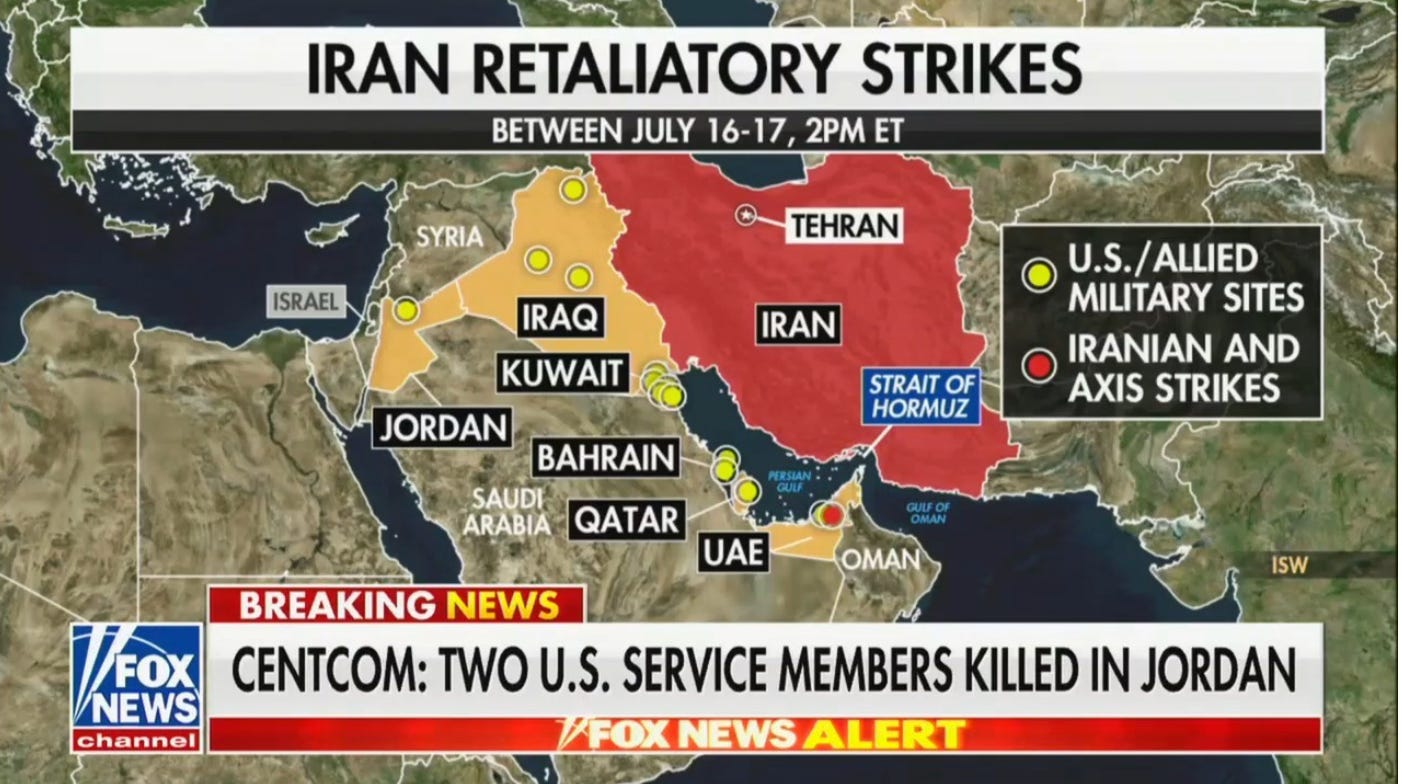
It is time to say the quiet part out loud.
For all of the rhetoric surrounding American strength, escalation, and resolve, the implicit political bargain that has guided Trump’s military policy has been remarkably simple: no American casualties. The promise has never been spoken quite so bluntly, but it hangs over every decision. Strike from the air. Launch cruise missiles. Fire long-range missiles. Employ drones. Use stealth bombers. Demonstrate strength. Just don’t bring home flag-draped caskets; it looks bad on TV.
That bargain helps explain much of the strategy we have seen. If airpower can accomplish the objective, use airpower. If standoff weapons can reduce the political risk, use standoff weapons. If there is even a possibility that ground combat could produce significant American casualties, avoid it if at all possible. The Iranians know this.
There is understandable logic behind that instinct. We spent more than two decades watching wars in Iraq and Afghanistan consume lives, treasure, and attention while producing results that often fell far short of the promises made at the outset. Trump’s war of choice against Iran sits at 29% approval. Americans aren’t weak. I’ve seen too many Americans bleed and die for me to buy that horseshit, but we do learn. A war like this is rarely as clean or as short as it is presented before it begins, and in this one, we just handed a new generation of Iranian leadership a chance to run a sequel to their national founding mythology of American defiance. Get ready for 40 years of embassy bombings, proxy wars, and maybe even a few exploding passenger jets (for old times’ sake).
And a reluctance to commit to sustained and expensive ground combat is not America’s weakness. It is the core of a democracy’s strengths.
Authoritarian governments can often conceal losses, silence dissent, and compel sacrifice indefinitely. Democracies cannot. Citizens ask whether a war is necessary. Parents ask whether the objective justifies the risk to their children, and voters demand explanations when casualties mount. Those questions are not signs of national decline; they are evidence that a free people still believe the lives of their service members possess immeasurable value. But Trump and Hegseth are trying to fight an authoritarian’s war in a 250-year-old democracy, and democracies ask questions about dead servicemembers.
There is a long history behind America’s faith in technology as a substitute for blood, and its biggest proponents have always been of the Hegseth-Lemay lineage: more violence with less risk. Since the Second World War, and particularly since the emergence of overwhelming American air superiority, policymakers have repeatedly hoped that precision bombing and technological dominance could achieve strategic goals without requiring large-scale ground combat. The dream is so seductive: overwhelming firepower with minimal American sacrifice.
But it doesn’t work.
Because airpower has never repealed the enduring reality that wars are ultimately contests of political will. Bombs destroy targets. They do not occupy territory, secure populations, build governments, or compel enduring political settlements by themselves. Again and again, Americans have hoped that this time would be different. Reality is more complicated.
The deaths in Jordan show the limits of the airpower approach, and in this ultimate sacrifice, what those young men deserve in return is clarity.
This is the other uncomfortable truth worth confronting. Political leaders of every party understand the power of the image of a flag-draped transfer case arriving home at Dover Air Force Base. Those images shape public opinion because they remind Americans that every strategic discussion eventually becomes deeply personal. Every casualty represents a family whose future has been permanently altered. Every folded flag marks birthdays that will never be celebrated together again.
Those images matter because the person inside the casket mattered, and the least their country can give them in return is honesty about why they were there, what mission they were serving, and whether that mission justifies asking others to accept the same risk. Democracies should never become comfortable with casualties, but neither should they pretend that technology has made sacrifice obsolete. Every time America sends troops into harm’s way, it incurs a moral obligation to tell the truth about the costs.
The thing that knocks the bottom out of Trump and Hegseth’s war is dead Americans. Iran knows this. That doesn’t bode well, and it’s about time we said the quiet part out loud.
I return again and again to this quote from T.R. Fehrenbach when I think of Tomahawk Cruise missiles and stealth bombers, “Americans in 1950 rediscovered something that since Hiroshima they had forgotten: You may fly over a land forever; you may bomb it, atomize it, pulverize it and wipe it clean of life—but if you desire to defend it, protect it, and keep it for civilization, you must do this on the ground, the way the Roman legions did, by putting your young men into the mud.”
Trump’s war, unpopular as it is, is based on ignoring this truth. Hegseth and Trump want us to believe they can defeat Iran on the cheap, yet if we’re going to be stupid enough to ignore what 75 years of contemporary history has taught us about American power, we owe it to the dead to be honest about how we failed them.
Excellent article. Unfortunately I believe nothing from Hegseth or that empty vessel. I believe our losses are higher, and most likely only the families will know the real truth. Thank you for always writing from your heart, it’s really appreciated.
Hegseth fired all the top commanders who had experience in command and strategy.