Ebola
Was The Canary In Trump Mine

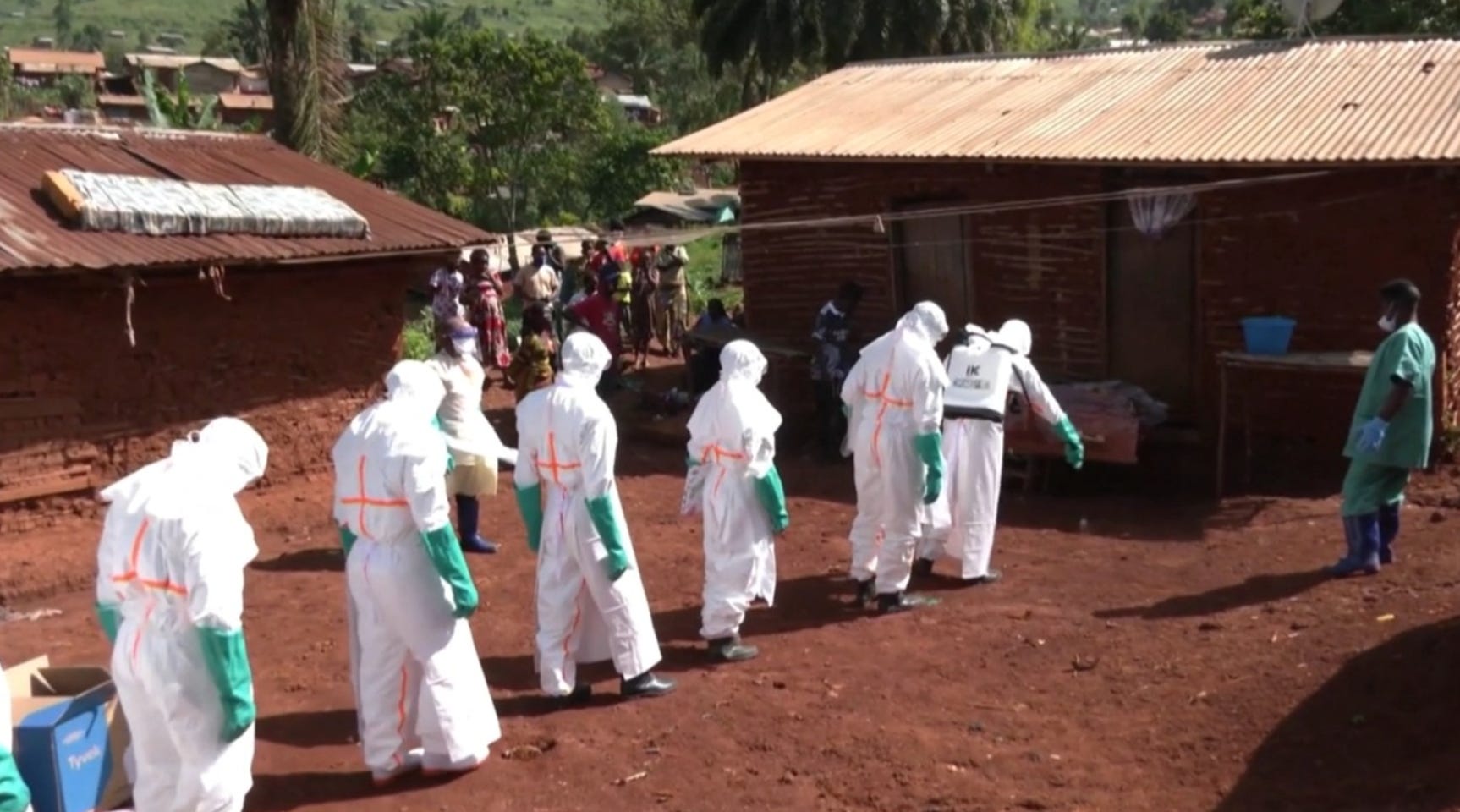
History is full of canaries that are only obvious in hindsight. I doubt many people watching the Spanish Civil War in the 1930s understood they were seeing a preview of the Second World War (aside from much of the Luftwaffe). Yet the conflict introduced many of the tactics that would soon define war in the second half of the 20th century: combined-arms warfare, strategic bombing, and the deliberate targeting of civilian populations. Likewise, when MTV debuted The Real World in 1992, no one would have predicted that an experiment placing strangers in a house together would evolve into one of the dominant forms of entertainment in the twenty-first century. Looking backward, the significance seems obvious.
I’ve thought, for some time now, that the same was true of the Ebola outbreak of 2014-2015. At the time, it was a frightening but ultimately contained public health emergency. A decade later, it perfectly presaged the chaos of Trump, the internet, and COVID.
I was a resident Emergency Medicine physician at the University of New Mexico during the outbreak. Ebola occupied an outsized place in the public imagination. The disease itself was terrifying: death from multi-system organ failure and coagulopathy causing massive hemorrhage. Images from Liberia, Sierra Leone, and Guinea showed overwhelmed healthcare systems, exhausted medical workers, and mortality rates that seemed almost medieval. Physicians who went over to Africa to work in the hospitals there, were held up as heroes, at least within the medical community. The suffering was real, and the outbreak ultimately killed more than 11,000 people in West Africa. Yet the fear that took hold in the United States often seemed disconnected from the actual risk Americans faced, especially (again, in hindsight) compared to the massive wave of deaths COVID would drop on us 5 years later. In emergency departments, patients worried about Ebola despite having no conceivable exposure. Cable news ran endless coverage, and every domestic case became a national event.
Eleven. That’s how many cases there were in the US, and none of them resulted from community transmission.
What stands out most in my memory, however, is not the disease but the reaction to it. I remember a real estate agent I knew in Virginia Beach posting incessantly on Facebook. She was a little out there at baseline (real estate agents often are), and she became convinced the government was hiding the truth, that public health officials were minimizing the threat, and that a global pandemic was inevitable regardless of what experts said. Travel from Africa, she argued, should be halted immediately.
Again, she was a real estate agent in Virginia Beach.
The details of her arguments have faded, but it was identical to the reactions the internet would auto-populate with when a real pandemic hit. If you were willing to spend enough time online, gradually shifting your own Overton window and beginning to climb the first hill of the Dunning-Kruger effect, you could discover what was really happening.
At the time, I regarded those claims as bizarre panic. Looking back, they seem like an early glimpse of a much larger transformation. Facebook was still at the height of its influence, and social media had begun changing not just how people communicated but how they formed beliefs. Traditional newspapers, television networks, universities, and government agencies became suspect because they were faceless, and crucially were never designed to win battles of information. Why would they be? They were the experts!
By 2014, those gatekeepers were losing their monopoly. Anyone with an internet connection could immerse themselves in a sea of information, half-truths, speculation, and conspiracy theories and emerge believing they possessed insights unavailable to the experts themselves. And by 2016, well…
What made this shift so powerful was that it offered something emotionally satisfying. Expertise requires humility, failure, and guided study. It demands acknowledging uncertainty and accepting that other people may know more than you. Social media rewarded the opposite. It rewarded certainty, confidence, and contrarianism. A public health official explaining that the risk of widespread Ebola transmission in the United States was extremely low sounded cautious and nuanced. A Facebook post declaring that disaster was imminent sounded bold and decisive. The algorithms did not care which was more accurate. They cared which was more engaging.
The Ebola panic also foreshadowed another trend that would become impossible to ignore during COVID: the collapse of the distinction between public policy and politics. Technical questions became tribal markers. Positions on quarantines, travel bans, and public health recommendations became signals about identity. People began sorting themselves into camps, and membership in those camps often determined what facts they found persuasive. The substance of the argument became less important than the side advancing it.
This transformation was accelerated by a kind of depersonalization that social media encouraged. Experts became profile pictures. Institutions became logos. Human beings with decades of experience became indistinguishable from anonymous accounts posting from basements and spare bedrooms. The epidemiologist who had spent thirty years studying infectious diseases occupied the same digital space as someone who had watched a handful of YouTube videos. Both appeared as boxes on a screen. Both competed for attention. The old cues that helped people distinguish expertise from speculation were eroding, and nothing effective had emerged to replace them.
When COVID arrived six years later, all of these trends exploded. Millions of Americans became amateur epidemiologists overnight, and everything was shut down aside from the internet. Every recommendation from public health authorities was scrutinized through a political lens. Scientific uncertainty was interpreted as evidence of dishonesty. Being accidentally correct about some early COVID “best educated guess” from the experts demonstrated to the online warriors that the medical community’s attempts to save the lives of elderly and immunocompromised Americans. The arguments that consumed the country during the pandemic often felt unprecedented, but all of the underlying patterns had already appeared during Ebola.
The irony is that public health experts were completely correct about Ebola. The disease never became the civilization-altering catastrophe many Americans feared. The outbreak remained concentrated in West Africa, and the handful of American cases never produced sustained transmission. Yet the people who distrusted institutions learned an important lesson from the episode. They learned they could build communities around skepticism itself. They learned they did not need newspapers, universities, or government agencies to validate their beliefs. They learned that social media could provide an alternative ecosystem in which official narratives were always suspect and, if your goal wasn’t to save lives but to win arguments on Twitter, “doing your own research” was more than enough.
Those communities did not disappear when Ebola faded from the headlines. They grew, migrated to new platforms, and were weaponized in support of Donald Trump. They became more sophisticated, more organized, and more influential. By the time COVID emerged, the infrastructure was already in place. The audience and distrust sat there, waiting.
The new Ebola outbreak in Africa still commands respect among physicians and public health professionals, but it no longer dominates the national conversation. Compared with COVID, it feels almost quaint. This is misleading. Like the Spanish Civil War before World War II or The Real World before the age of reality television, the 2014=2016 Ebola outbreak exposed a future that was still difficult to recognize. The outbreak was a canary in the coal mine.
Someone should write a book about it.
Superb dispassionate analysis of a complex and deepening problem that dogs us still and even more now than before, deliberately stoked by the dear leader. Covid was insidious in part because many people who could infect others didn’t even know they had it. This and the fact that it was not deadly or even a big problem for many who contracted it allowed people to claim it was bogus. It strikes me that Ebola would be somewhat less susceptible to either claim. Perhaps a future superspreader political rally will prove me wrong. Nicely done.
The greater concern for any potential outbreak is our withdrawal from WHO and destruction of USAID. Already the NYT has published reports of 600K dead mostly women and children from malnutrition and lack of medicine. If you factor in everything you wrote about, it will certainly be millions more.