J.D. Khrushchev
And Trump's Nap Habit

Political movements built around a single leader face the same problem: what happens after the leader is gone?
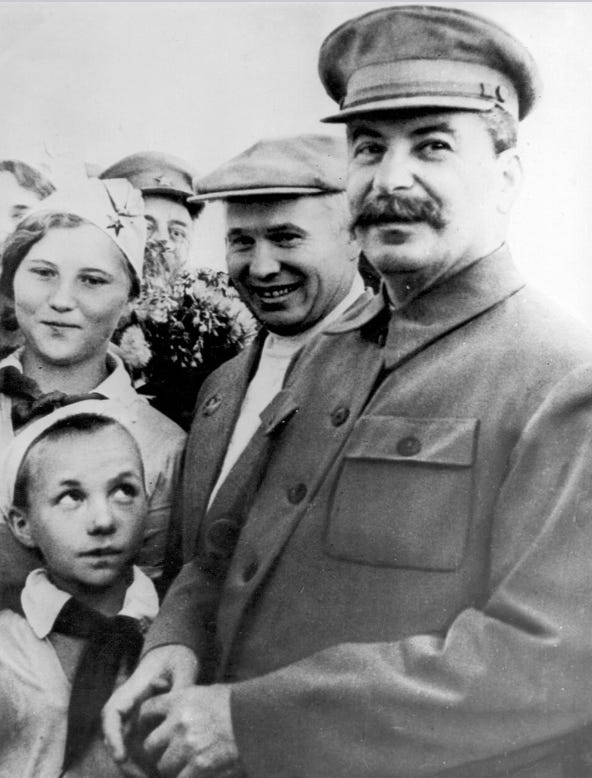
And in case you haven’t noticed, Donald Trump has clearly entered the “who made this shower so slippery?” stage of life.
When Joseph Stalin died in 1953, the Soviet Union was not merely governed by a dictator. It had been shaped by a cult of personality so pervasive that millions of citizens understood reality through Stalin himself. His image hung everywhere, and between the purges of the 1930’s and the Nazi invasion, there was never a question of who, in every and all circumstances, ran the show. Stalin lived by the Louis the 14th adage, “L’État c’est moi.”
Yet within a few years, one of Stalin’s own lieutenants dismantled much of what Stalin had built.
Nikita Khrushchev was no liberal democrat, and certainly not a capitalist. He had served Stalin faithfully and was implicated in many of the regime’s abuses. But he understood something essential: Stalinism had become a dead end. The terror, the purges, and the cult surrounding Stalin threatened the survival of the Soviet system itself.
In 1956, Khrushchev delivered his famous “Secret Speech” to the Communist Party Congress. The speech did not reject communism or Soviet power. Instead, it separated the Soviet project from Stalin personally. Khrushchev condemned the cult of personality, denounced many of Stalin’s excesses, and began a process known as de-Stalinization.
The reaction was immediate and fierce.
Hardline Stalinists saw Khrushchev as a traitor. Many had built their careers around absolute loyalty to Stalin. Others genuinely believed Stalin’s methods were necessary. Figures such as Vyacheslav Molotov, Lazar Kaganovich, and Georgy Malenkov eventually found themselves marginalized, pushed aside, or stripped of influence as Khrushchev consolidated power. These men had been giants of the Stalin era. Under Khrushchev, they became relics (he held a special enmity for Stephen Miller Kagonovich).
Khrushchev did not destroy Stalinism overnight. He couldn’t. The institutions, habits, incentives, and loyalists that Stalin created remained deeply embedded in Soviet life. When you have only known one political reality, contemplating another is kind of a whole thing.
The Soviet Union survived for another thirty-five years.
That is the lesson many people miss. The collapse of a political cult rarely occurs when the leader exits the stage. The collapse comes much later, after years of internal arguments about what should be preserved and what should be abandoned. The exceptions are violent deaths: Mussolini, Ceaucescu, Gaddafi.
Historians will view the post-Trump Republican Party through a similar lens.
Donald Trump has built the most powerful personality-driven political movement in modern American history. Like all historical analogies, the comparison has limits. The United States is not the Soviet Union, and Trump is not Stalin. But the political dynamic is recognizable. For many Republican voters, loyalty to Trump has often mattered more than loyalty to traditional conservative principles. Positions once considered essential to Republican identity have shifted or been tossed aside depending on Trump’s personal preferences, often in the moment. Personal allegiance has become the central organizing principle.
The question is not whether Trumpism disappears when Trump leaves politics. The question is who becomes the Khrushchev.
J.D. Vance is the most plausible candidate.
Like Khrushchev, Vance emerged from within the movement rather than outside it. He has demonstrated loyalty to its leader and understands its grievances and language. That gives him credibility with its supporters. Yet he is also young enough to imagine a future beyond the founding figure.
When Trump exits the political stage, which, for such a narcissist, will only happen when he exits the earthly stage, Vance will discover what Khrushchev discovered: movements built around one man eventually become a burden for the people who inherit them.
At some point, Republican leaders will need to explain the controversies and failures of the Trump era. They will not repudiate everything. Khrushchev did not repudiate communism. He repudiated Stalin’s cult. Republican electeds will fall over themself trying to brand themselves as populists in opposition to elites while distancing themselves from Alex Pretti, gas prices, and Iranian drone strikes in Kuwait. It won’t be easy.
The big losers, justly, will be the true believers like the Stephen Millers and the Kash Patels.
Marco Rubio, Vance, and others may one day compete not to demonstrate loyalty to Trump, but to demonstrate independence from the most polarizing figures and episodes of the era, just as Khrushchev elevated himself by criticizing Stalin’s inner circle. There will be “a” fall guy. More than one, in all actuality.
It’s an old pattern. Today’s loyalists become tomorrow’s scapegoats. Yesterday’s indispensable advisers become evidence that the new leadership has changed course.
Ask Henry Kissinger.
The irony is that such revisions are often carried out by true believers. Khrushchev was not an outsider overthrowing Stalinism. He was a product of it. The people most capable of reforming a movement are frequently those who helped build it.
That is why the most important political battles often occur after a dominant leader’s peak. Once the central figure is gone, the struggle shifts from loyalty to legacy. Which figures are celebrated, and which are erased from official memory?
JD Vance, chameleon that he is, is deeply invested in being a part of the former and not the latter. His lukewarm hedge on the Iran war will be his angle, combined with his teary reminiscence on 60 Minutes someday soon of whatever poll-tested purported words of wisdom Donald Trump gave him in private about Truth, Justice, and America. Of course, those words were never spoken, because Trump doesn’t think about anyone beyond himself, and Vance, perhaps more than anyone in America, knows that picking up the mantle of the Dear, Departed Leader requires a little bit of buffing the brand.
Peter denied Jesus three times; Vance will make the second half of his life about it.
Dr. Barkhuff interesting read.
It depends on what type of movement you’re talking about. Real political movements are built on ideas, policy, governing philosophy, and a vision that improves the human condition. Those movements can survive the departure of a leader because the principles outlive the individual.
MAGA is different.
MAGA was never about governance. It evolved from grievance politics, racial resentment, culture war nonsense, and personal loyalty to one man. Nearly ten years later, where is the healthcare plan? Where is the long term economic strategy? Where is the plan to lower housing costs, childcare costs, insurance costs, prescription drug costs, or improve the lives of working Americans?
It doesn’t exist.
A movement built on institutions, ideas, and policy can endure. A cult of personality eventually runs headfirst into reality. Stalin’s Soviet Union struggled with succession despite having an entire state apparatus, a governing ideology, and millions of true believers behind it. MAGA has an even bigger problem because its entire identity begins and ends with Donald Trump.
The question is not whether Trump leaves the stage. Time is undefeated. The question is what remains when he does.
History tells us that movements fueled by anger, fear, resentment, and loyalty to a single leader eventually fracture into competing factions the moment the leader is gone.
And let’s not forget that Stalin’s purges left a lot of angry officers and political rivals. Hundreds of thousands were imprisoned, exiled, or executed. Large portions of the Soviet military leadership were wiped out. Yet the Soviet Union endured because the generation that survived those purges then endured World War II together. The Soviet people paid an unimaginable price. Roughly 27 million Soviet citizens died in that war. Millions of soldiers. Millions of civilians. They shared sacrifice, suffering, and survival.
Many of the men who later supported de-Stalinization weren’t outsiders. They helped build the very system they later criticized. Khrushchev was one of them. He eventually recognized that the cult of personality was threatening the long term survival of the state itself.
That’s where I see the major difference with MAGA.
“Make America Great Again” is not a governing philosophy. It’s a slogan. A brand. A cult of personality wrapped around one man. There was never a serious plan to address healthcare, wages, education, infrastructure, housing, or the everyday economic struggles facing most Americans.
The movement ran on outrage.
Now Americans are beginning to feel the consequences in their wallets. Grocery prices. Housing prices. Insurance. Healthcare. Utilities. Everyday necessities. Political slogans sound great until the bills come due. Then people stop cheering and start checking their bank accounts.
History also tells us that personality cults don’t disappear overnight. They fracture. Loyalists fight over who the rightful heir is. Scapegoats emerge. Narratives get rewritten. Yesterday’s loyalists become tomorrow’s historians and revisionists.
Which brings us to J.D. Vance.
Dr. Barkhuff as you stated, Vance is a political chameleon. His political identity has changed repeatedly, and hell, he’s changed his name four times throughout his life. That doesn’t automatically disqualify someone from leadership, but it does raise questions about consistency, conviction, and who exactly is showing up to govern.
The bigger issue is that nobody knows what version of J.D. Vance they are getting. The Trump critic? The populist nationalist? The Silicon Valley venture capitalist? The MAGA heir apparent? It seems to depend on what room he’s standing in.
Our Constitutional Republic is too fragile, too angry, too divided, and frankly too exhausted to gamble on uncertainty.
The real irony is that if Trumpism follows the historical pattern, many of today’s loudest MAGA voices will quietly slip back into society pretending they never supported any of it. They’ll tell us they were misunderstood. They’ll tell us they were trying to moderate the movement from within. They’ll tell us they were never really MAGA in the first place.
We’ve seen this movie before.
Yesterday’s true believers become tomorrow’s deniers.
Because when personality cults collapse under the weight of reality, very few people volunteer to admit they helped build them.
I thought of T. S. Eliot’s epic poem ‘The Hollow Men’ when you were drawing a historical analogy between those who succeeded Stalin vs those after Trump. Eliot speaks of men who lack both ‘intellect and soul’ and the current crop of Trump’s sycophants qualifies both ways although in a Vance/Rubio contest, who knows?