On Cornyn

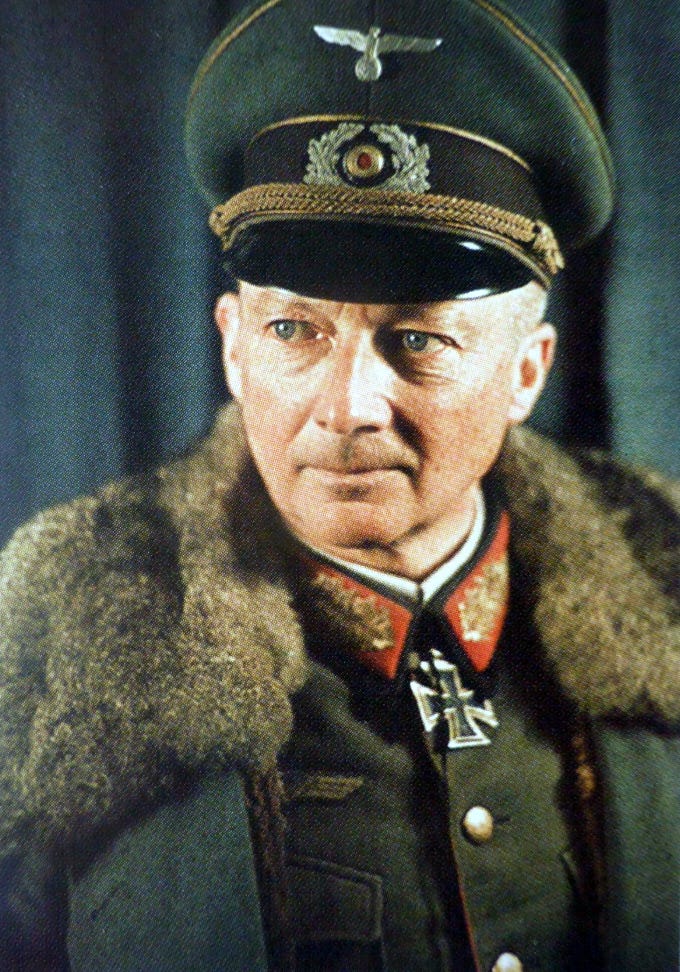
Field Marshal Günther von Kluge is still studied at places like United States Military Academy (West Point) and Sandhurst, not because he was a hero, but because he represents one of the most important and dangerous types of leaders: the intelligent, institutional man who recognizes disaster, but can’t quite bring himself to do what he knows he should.
Von Kluge was one of Germany’s best commanders during World War II. He wasn’t a committed Nazi ideologue in the mold of Wilhelm Keitel or Walter Model. He understood Hitler was reckless and ultimately catastrophic for Germany. But that is precisely why military historians continue to examine him. He epitomizes the moral and institutional failure of talented men who know better, while abetting systems they privately recognize as dangerous.
Like John Cornyn, Bill Cassidy, and Chip Roy.
The comparison is not that Trump is Hitler or that modern America is Nazi Germany. Those are lazy analogies. The comparison is behavioral. It is about institutional capitulation. It is about men who clearly see the danger posed by a political movement, privately acknowledge it, occasionally even criticize it, but ultimately convince themselves that remaining inside the system is more important than confronting it directly.
That was von Kluge’s defining instinct. Stay inside the room. Preserve influence. Moderate the damage. Avoid open rupture. Every compromise was justified as temporary or strategic.
Sound familiar?
You could see the same pattern after January 6th. Most Republican senators knew exactly what had happened. Privately, most said Trump had crossed a line. Publicly, some briefly condemned him. And then Kevin McCarthy made his infamous trek to Mar-a-Lago. The calculations took over: what happens to the party, the coalition, the donor base, the judges, the next election?
That is the von Kluge mindset. Not fanaticism, accommodation.
Dan Crenshaw reluctantly saddling up a tiger.
History is harsher toward accommodators than they expect. Von Kluge hesitated around the July 20 plot against Hitler, flirting with resistance but never fully committing. He waited to see which way events would break. When the plot failed, he tried to retreat back into loyalty. By then, nobody trusted him, not Hitler, not the resistance, and ultimately not history.
That is worth studying. Democracies and institutions are rarely destroyed solely by zealots. They are weakened by respectable, intelligent men who know better, yet continually postpone the moment when they are willing to risk their careers, status, or comfort in defense of the system itself. They are weakened by enough people, enough of the time, choosing to balance the preservation of their career and relevance with danger.
Adam Kinzinger and Dietrich Bonhoeffer, they are not.
Von Kluge’s tragedy was not that he lacked intelligence. It was that he lacked the willingness to decisively act while action still mattered. He wanted moral distance without personal institutional sacrifice. History rarely permits both, and Donald Trump has permitted neither.
“We are our choices.” - Jean-Paul Sartre
You can only ride the tiger until he decides it’s your turn to be eaten, all of these accommodating Republicans lawmakers who Trump holds in contempt never seem to get that until they’re gone.