On Errors

As I write this, I’m fortunate enough to be on Oahu, looking across Turtle Bay at the Opana radio station. For those of you who don’t know, this is the radar station from which the American military detected 183 inbound Japanese aircraft on December 7th, 1941. The Lieutenant on duty that morning, Kermit Tyler, on his second day at the radar, made the logical, peacetime conclusion that the massive radar blip was a flight of B-17 bombers inbound from the US mainland. A completely logical conclusion, and a completely wrong one. It got me thinking about mistakes, and all the life left to live after we make them. It got me thinking about Bill Buckner.
By the fall of 1986, Buckner had already lived the kind of baseball career most players would gladly accept. Over twenty-two seasons he collected more than 2,700 hits, won a batting title, and earned a reputation as one of the toughest competitors in the game. He wasn’t remembered for 500-foot home runs or impossible athleticism, but because every season amidst the ice packs and cortisone injections he answered the same question with the same response: show up tomorrow and do your job. His ankles were ravaged by years of playing through pain, but he kept taking the field. He was, in the parlance of the times, a gamer. In another world, that would have been his legacy.
But it wasn’t to be.
Game 6 of the 1986 World Series should never have come down to Bill Buckner. The Boston Red Sox were one out away from their first championship in sixty-eight years. Champagne was already waiting in the clubhouse at Fenway Park on a cool October night. Across New England, children who had been allowed to stay up long past bedtime believed they were about to witness something their parents had spent a lifetime hoping to see. I was one of those kids. My father had grown up in Springfield, MA. My maternal grandfather in Lowell. It was in my blood, and I can still tell you, from memory, the 1986 Red Sox lineup. Like millions of Red Sox fans, I had grown up hearing about the Curse of the Bambino, the belief that selling Babe Ruth to the Yankees in 1919 had condemned Boston to generations of heartbreak. The greatest hitter of all time, Ted Williams, had never won a World Series. Neither had Carl Yaztremski or Carlton Fisk. Whether anyone truly believed in curses didn’t matter. We believed in history, and the history of the Boston Red Sox, for anyone still alive in 1986, was losing enough to define the Red Sox experience in its entirety. But on that chilly evening, it looked like it was all coming to an end. But then...
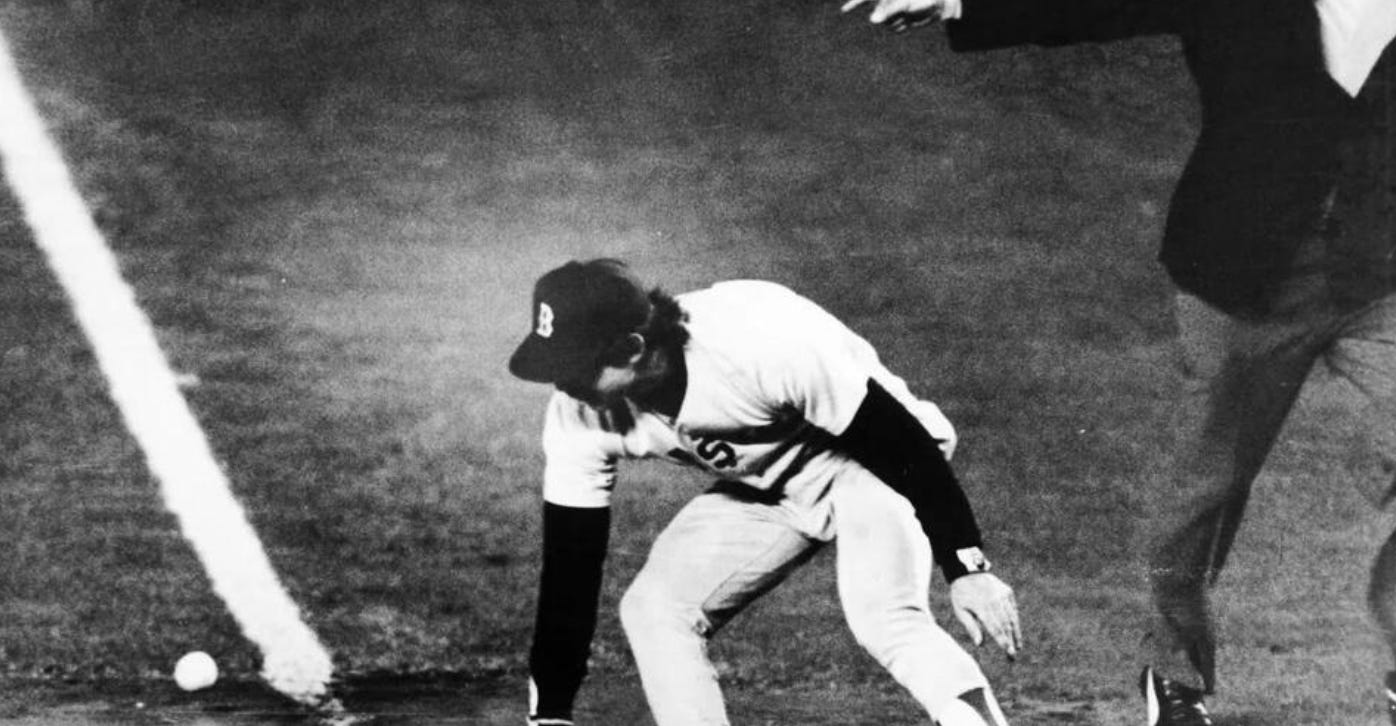
A walk put a runner on base. A single became another baserunner. Bob Stanley uncorked a wild pitch that allowed the tying run to score, and by the time Mookie Wilson stepped into the batter’s box, what had felt inevitable had become uncertain. Wilson chopped a slow ground ball toward first base. Buckner broke forward, bent to field it, and the ball skipped beneath his glove before rolling into right field as Ray Knight crossed home plate with the winning run. The Mets won Game 6 in a silent stadium, and completed the comeback the following night, taking Game 7 and the World Series with it.
The play became one of the most famous errors in the history of American sports. It also became one of the most misleading because the Red Sox had already squandered a two-run lead. Stanley’s wild pitch had tied the game before Wilson’s ground ball ever left the bat. Roger Clemens had been removed earlier than many, including seven-year-old me, thought he should have been. There were missed opportunities throughout nine innings, and any one of them could have changed the outcome. The defeat had accumulated; it had not been dumped in one fell swoop.
Memory, however, doesn’t work that way. We prefer tidy stories about blame, and instinctively search for a face to attach to failure because it is easier to understand than a web of small mistakes. Buckner instantly became that face. His name ceased to belong to a man directly responsible for the Red Sox appearance in the Series and became shorthand for collapse.
The reaction that followed, even before the days of social media, was quick, brutal, and astonishing. He received death threats, and reporters hounded his family. His name became a punchline in late-night comedy and a cautionary tale in sports. An entire career disappeared beneath a five-second highlight that television replayed endlessly. Even without Twitter or Facebook, outrage found a way to spread. In New England, his name became mud.
I believed it too.
When I was a boy, I absorbed the opinions of the adults around me without realizing I was doing it. I remember hearing fathers, coaches, and sports radio hosts talk about Buckner with contempt, and I accepted their judgment as my own. Looking back, I wasn’t evaluating Bill Buckner but rather learning how tribal loyalty works. I mistook outrage for wisdom because it was a visible and imitable way to be a part of the club. I hated Buckner.
Several years later, Buckner hosted a baseball clinic in Nashua, New Hampshire, just across the Massachusetts border from where I grew up. It became a topic of conversation among kids in my hometown. Some proudly declared they would never attend anything associated with Bill Buckner, as though refusing to spend a Saturday at his camp might somehow punish him. We were children pretending to exercise moral judgment, but in reality we were simply echoing the adults we admired even though they, in hindsight, were acting as children do. We thought we were demonstrating loyalty to a tribe. We were holier than thou.
Before I went to the clinic, my father quietly interrupted that narrative.
“Bill Buckner is an incredible baseball player,” he said. “And the Red Sox don’t even get to the World Series without him.”
I imagine I was silent at this. If my dad didn’t hate Bill Buckner, maybe I was missing something? Until that moment, Buckner had existed in my mind only as the man who let the ball roll through his legs. I had never considered that he had also spent twenty-two seasons doing everything required to put himself in that position in the first place. Without Bill Buckner, there is no heartbreaking Game 6 because there is no World Series appearance at all. I went to the clinic.
As I grew older, another part of Buckner’s story began to matter even more: he never hid behind the truth: the Red Sox had many opportunities to win that game before the ball reached first base. The truth was that his ankles were so damaged he should probably have been replaced defensively. The truth was that the game had already begun slipping away before Mookie Wilson stepped into the batter’s box. The truth was that blaming one player for an entire World Series loss was irrational. There were seven games!
Every one of those statements was accurate, and Buckner could have repeated them every time a microphone was placed in front of him, and he would have been right. Instead, he said something much simpler, “I should have made the play.”
Bill Buckner never claimed the loss was entirely his fault, because it wasn’t. He never argued that he deserved the hatred directed toward him because he didn’t. He simply accepted responsibility for the part that belonged to him and didn’t sabotage his own manhood by trying to dilute it through pointing out the screw-ups of others. That’s the difference between blame and accountability. Blame insists the burden is distributed to others, and accountability appears in the mirror and asks if you have carried your share.
Buckner either consciously or unconsciously understood that distinction. By refusing to defend himself, he surrendered something that most of us cling to desperately: the need to win the argument. In doing so, he gained something far more valuable. He remained a man whose integrity could not be measured by a batting average or a highlight reel because it had already been revealed in the way he carried failure.
More than twenty years later, after the Red Sox finally won a World Series (that I had watched in a mess hall surrounded by thick Boston accents at 3 in the morning in Baghdad), when Buckner returned to Fenway Park, the crowd rose to its feet. The ovation lasted for several minutes. It was emotional, heartfelt, and overdue. In it was some measure of public apology, a penance of applause. The fans had not forgotten the error, of course. But the ‘04 win restored some measure of sanity to the mob, and we realized that the defining moment of Buckner’s life was not the ground ball; it was everything that followed. The applause was in recognition of a man who had endured extraordinary humiliation at their hands without becoming bitter, dishonest, or self-pitying. Bill Buckner was an athletic champion, and he carried himself as one even when, as he must have felt for many years, he was alone.
As a boy, I thought Bill Buckner’s story was about failure. But it wasn’t; it was about character. Anyone can accept responsibility when success makes the cost small. The true measure of accountability is whether you still accept it when there is real consequence attached. Buckner spent the final decades of his life answering that question every time someone asked him about a ground ball, and every answer reflected the same quiet conviction: I should have made the play.
Kermit Tyler ended up getting a bad rap too out of Pearl Harbor. He was blamed for it not just in military circles, but in blockbuster Hollywood movies (Tora! Tora! Tora!). Like Buckner, he didn’t deny or protest in any of the several official inquiries into his role. What he did do was spend the next twenty-five years proving that a single mistake, even one forever linked to infamy, need not define a life. He continued flying combat missions in the Pacific, even commanding fighter wings, and he accepted history's judgment with quiet courage, not hysterics and conspiracies.
Failing in life, sometimes in big moments, is not optional. How we deal with it is.
Thank you for this lovely, thoughtful commentary about the courage to stand up and take, not shirk, responsibility for one’s actions. Integrity is so absent in our common culture, most particularly in the political sphere.
An exceptional—and timely story, beautifully told. The timeless lesson from Bill Buckner and Kermit Tyler is that strength of character is the mark of a real professional—no matter the field of endeavor.
Wouldn’t it be grand if a copy of these 1,732 words could be place in the hands of every school kid in America? This is the kind of seed that needs to be planted in young minds who will confront the consequences of our current challenges in sustaining Our Great American Experiment.
It will rise or fall on character. That hasn’t changed in 250 years.