On Gold Stars

The domestic debate over the Iran war has largely been conducted in dollars as groceries become more expensive every week and it costs a hundred bucks to fill up your F-250. For most, the economic burden is the most visible consequence of the conflict: immediate, measurable, and impossible to ignore. Every act of participation in the economy is clear, less for you, more for “them.”
But it’s not the cost that will endure the longest, because the true price of war is paid somewhere else entirely by the families who wake up one ordinary morning and, by sunset, belong to the most exclusive and saddest club in America: Gold Star families.
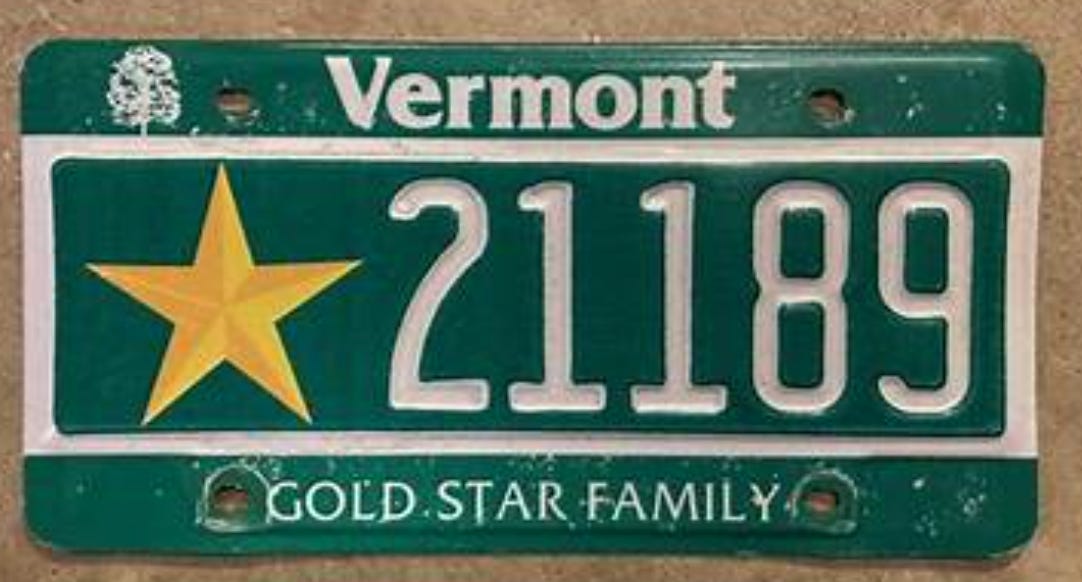
There is no accurate count of how many Americans belong to that fraternity. There are simply too many wars, too many generations, and too many parents, spouses, brothers, sisters, and children whose lives were divided forever into “before” and “after.” But they are simply among us. The woman standing behind you in the grocery line. The father watching Little League from the outfield fence. The widow still wearing her wedding ring years after an IED exploded someplace marked on a military map as MSR Tampa. Vermont and, I’d imagine, other states as well, provide Gold Star Family license plates to those who lost a loved one in war. A permanent reminder to every motorist that sees it on their daily commute, that people died for all we enjoy. A reminder that visible is ironically fitting on a highway, surrounded by the machines for which our interest in the Middle East originated.
I always let them merge in traffic.
The license plate doesn’t remind the families themselves, though. That is the empty chair at Christmas dinner that no one sits in because everyone knows whose place it was. The empty chair is the cost of war.
There are baseball games that will never have a father in the dugout yelling, “Good swing buddy!” There are daughters who will walk down wedding aisles without someone waiting to take their arm. There are fishing trips to the lake that will never happen, camping weekends that will never be planned, and graduations with embraces accompanied by whispered “She would be so proud of you.”
History records battles, but families don’t. Families don’t need to record holes in their hearts.
It is easy, especially for those of us who have worn the uniform, to fall into the language of duty. Service, honor, and sacrifice are reflected on because those words matter. They are true. But honoring sacrifice also means refusing to make it cheap. Every American sent into combat carries with them an entire future that may never be lived. Their death is not one life lost. It is decades of conversations that never occur, holidays that never happen, grandchildren never held, anniversaries never celebrated, ordinary Tuesdays that vanish before they can exist. This is a nation founded on the idea that certain truths are self-evident: all men are created equal and have a natural right to life, liberty, and the pursuit of happiness.
Unstated, but underlying this, is the simple belief that human life has value. Real value. It is not cheap, and we must not treat it as if it were.
Someone must treat these lives as the gift that they are. Yesterday afternoon, in the too-little-too-late Republican Senatorial meeting, Bill Cassidy publicly criticized President Donald Trump’s decision-making surrounding this conflict. At this point, there may be little political advantage in doing so, he lost his primary. I hope, though, that some of that anger was directed not merely at strategy or process or gasoline prices, but at what strategy ultimately becomes. Perhaps somewhere beneath the political argument was an understanding that thirteen body bags are not simply thirteen casualties. They are thirteen violently pruned family trees. Thirteen households were permanently divided into “before” and “after.” Thirteen new Gold Star families who never volunteered for that title.
Wars are sometimes necessary. American history is full of moments when the alternative to fighting would have been morally worse, and the line is not always scale. There are plenty of “small” conflicts in which it has been right for the US to “put warheads on foreheads” in the bro lexicon of such strikes.
But necessity is not the same thing as carelessness.
We should never become so accustomed to precision-guided weapons that we lose precision in our moral accounting. It does not have to be Antietam. It does not have to be the Battle of the Bulge. It does not require thousands dead before we ought to pause to acknowledge what has happened.
If the United States asks even one citizen to die, that decision deserves gravity, and if it asks thirteen, then thirteen families deserve more than a passing mention in a press conference.
I do not expect Donald Trump to dwell on that cost. His public life has rarely suggested an interest in grief that is not his own. But someone in the American government should say, plainly and without euphemism, what happened. We asked thirteen young Americans to risk everything in a war of our choosing. They did exactly what their country asked. They were blown up, into little tiny pieces, in Kuwait and Iraq, where we have been leaving American blood to dry in the dust my entire life.
Is it too much to ask elected representatives of the United States to speak that truth?
The real memorial to war is not built from granite in Washington next to the algae pool. It is built every spring beside Little League diamonds where a father should have been coaching first base, and it is built at wedding ceremonies where someone quietly places a photograph in the front row. It is built on quiet summer mornings at lakes that families no longer have the heart to visit.
We have elected an abject moral failure who swims in cowardice and narcissism to lead us. This coward, Donald Trump, has done more to damage this nation than any American since Jefferson Davis. In Pete Hegseth, all of this has been enabled by a small man so insecure in his manhood that he cheers war with cringy rhymes. But most of this damage, despite its gravity, is reparable.
Black body bags, inside aluminum, flag-draped coffins on a tarmac in Delaware en route to Arlington, are not. We must not forget that.
Daniel. As a 56 year old Gold Star son, Thank you. Well said. Sadly, those families are now part of my family.
This sucked the air out of me. Is it too much to hope that proper tribute will be paid someday to the thirteen fallen and their families? It is bad enough that they died; the regime's indifference is intolerable. The Iran war is the greatest humiliation this country has ever experienced. The whole world is laughing, cringing, gamely experiencing schadenfreude at our expense. The holes in the baseball games, the weddings, the things that make a life, should haunt us all. I will never forgive trump for his perfidy. The best tribute we can pay is to defeat these cowardly dogs and bring grace and gratitude back to the nation.