
Last night, my phone buzzed. Steve Kornacki.
Yes, that Steve Kornacki, the one standing at the election board. I’ve known him for 41 years. Our parents were friends, and we played together as boys in rural Massachusetts. As we got older, our interests in sports took different forms. I wanted to be the star. Steve wanted to know what the numbers said.
In middle school and high school, I was a starting guard, and Steve was our basketball team’s manager. In his case, that meant keeping the scorebook and tracking our stats in what was, for the time, a state-of-the-art spreadsheet. He still has it somewhere, which means I can never claim my three-point percentage or assist-to-turnover ratio was exceptional, or even good. Eight points a game in small-school New England basketball was hardly a fast track to the NBA.
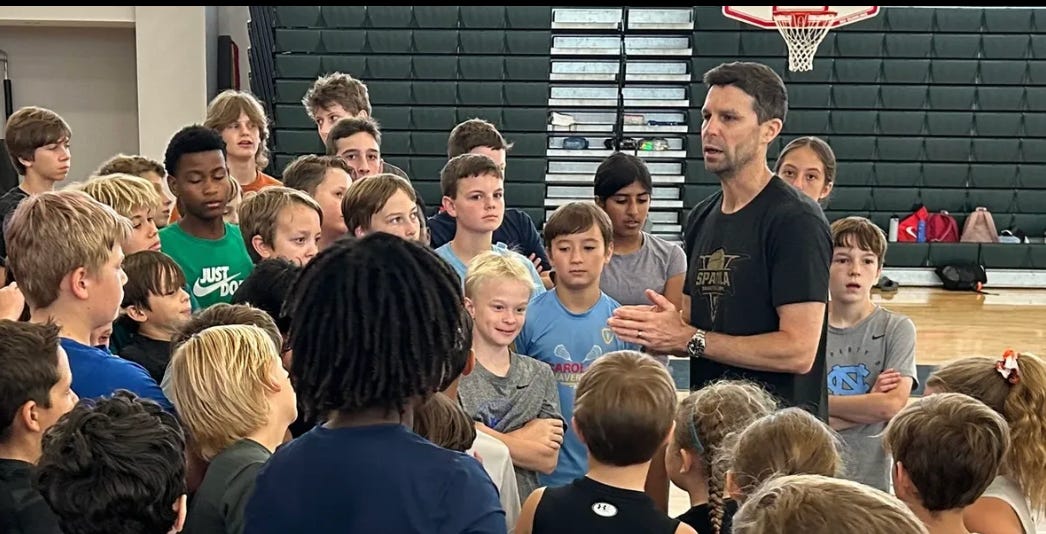
But there was another kid on our team who was good, and he was the reason Steve was texting. Our point guard, Chris Spatola, was another childhood friend. Chris could score and dish out assists seemingly at will. When we played bigger towns outside Boston, he was usually the only one of us who looked entirely at home on the court. We once scrimmaged Somerville, and Chris was the only one who could reliably get the ball past half court.
Chris went to West Point, where he played basketball. I went to Annapolis and walked on to the track and cross-country teams. We both served in Iraq, and one memory I have is him telling me, “Man, my father-in-law would be so pissed because we played a 2-3 zone” during the base basketball tournament. His father in law, of course was the great Duke coach and father of the bride, Jamie Krzyzewski. Chris built a career around the game, including work as a college basketball announcer for ESPN and running a basketball camp in North Carolina in the summer.
We had lost touch for a few years, then reconnected recently. We had spoken just days before Steve’s text. He wanted to follow up with me about something he had offered to do, and now Steve was sending me an article announcing Chris’s death. I read it, and then I read it again. I don’t know what happened; I don’t know how Chris died, but I worry I missed flags.
I have rarely felt like an imposter in the places where I’ve spent my adult life. In a trauma bay, I knew I could resuscitate a patient. In the SEAL Teams, I had carried the boats and sat in the cold water with everyone else; after combat, I knew I belonged there and wouldn’t run. I felt much the same on the jiu-jitsu mats and in a boxing ring. I was never an all-time great at any of it, but I knew what I was doing, enough to keep myself safe and contribute some amount of what needed to be contributed.
Certain people, though, have always been able to make me feel like a fish out of water. A certain demeanor with a certain level of success at something I valued was the elixir. Chris was one of those people.
We spent several summers together at Pocono Invitational Basketball Camp in Pennsylvania. This was when Bobby Hurley played for Duke. One summer Chris played Hurley one-on-one. Hurley smoked him, but Chris at least looked like they were playing the same sport. Chris made the camp’s All-Star Game. I was somewhere in the stands.
Playing beside him made me tense. I worried he would thread a beautiful pass to me and I would miss the wide-open shot. I worried I wouldn’t stop my man on defense and Chris would be angry. His ability baffled me. I was so busy anticipating the moment I might disappoint him that I could hardly enjoy being on his team. He had real talent. One year, Army played Duke on ESPN. Chris had 15 points. Not bad. Especially considering it was his younger brother JP who really had the talent.
That feeling of being on eggshells stayed with me longer than the basketball did. Even when we reconnected as adults, I sometimes found myself listening for evidence that Chris thought I measured up. If he seemed distant, I took it personally. If he sounded sure of himself, I heard arrogance. I thought I was reading him, but much of the time I was watching myself through what I imagined, probably incorrectly, were his eyes.
Now I know he was struggling in ways I did not see. I keep revisiting conversations, wondering whether what I heard as indifference might have been exhaustion, or whether the confidence I envied was something he needed to hold himself together. I don’t know. His death doesn’t give me the right to diagnose him after the fact, or to turn every ordinary exchange into a clue I should have caught. It does make me wish I had been less concerned with how I came across and more curious about how he was doing.
I used to think the chief cost of feeling like an imposter was that it kept you from taking your place. You hesitate, you hold back, you spend your energy proving to yourself that you belong. But there is another cost. When you are preoccupied with your standing in someone else’s eyes, you can lose sight of the person standing in front of you. Chris was my friend. We both loved basketball. He was better at it, which just meant I spent too much time worrying about whether I belonged beside him to ask what it felt like to be him.
I remember the passes. I remember the fear of missing them. What I ought to remember now is that he kept passing me the ball. We had known each other since we were boys, and after years apart, we had found our way back into conversation. I wish I had asked him more questions while I could. I wish I had listened without waiting to learn something about myself. Maybe he had tried to tell me something.
A very sober and reflecting look at friendship and realities in life. Thanks for your memory.
Having recently lost my brother, this resonates. Take good care of you and those you love.