On Mangione

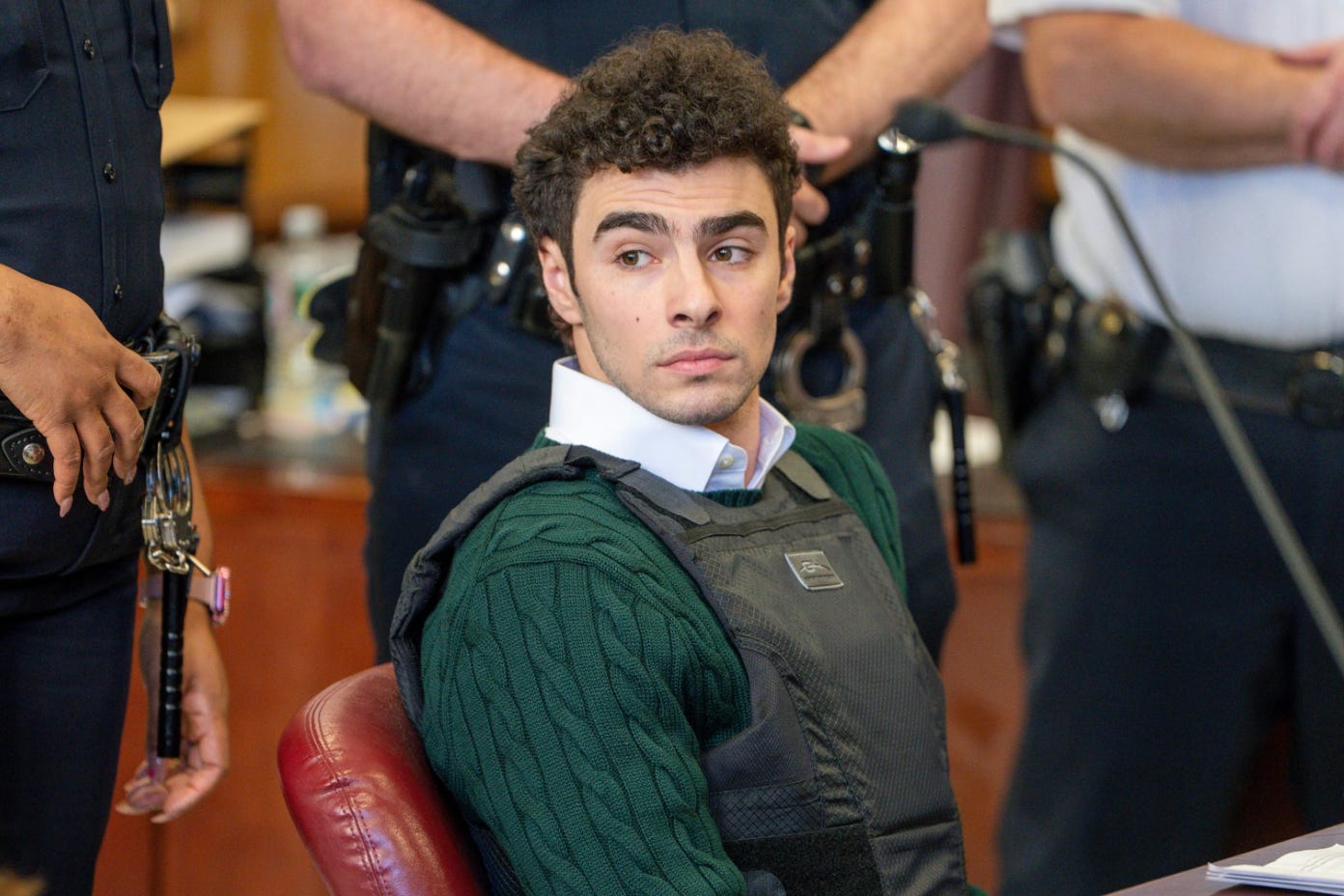
Luigi Mangione pleaded guilty yesterday, not to murder, but to two federal stalking charges arising from the killing of UnitedHealthcare CEO Brian Thompson. He admitted in open court that he tracked Thompson, traveled to New York, and shot him outside a Manhattan hotel. He almost certainly will spend the rest of his life in federal prison, with a separate New York state prosecution for murder pending.
Somewhere over the course of my life (don’t remember where exactly), I heard an observation about murder that has stuck with me: almost all murders are committed by really stupid people seeking permanent solutions to temporary problems. Somebody needs money for meth, so he robs a convenience store. The clerk resists, or maybe he simply recognizes him, and suddenly a problem that might have lasted until Tuesday becomes a dead human being and a prison sentence that lasts until the murderer dies. Murder is a lot of things: evil, tragic, pathological, but it’s also most often spectacularly stupid. I have a problem; this person is associated with my problem; therefore, removing this person will remove my problem.
Mangione is interesting precisely because he does not fit our preferred stereotype of the stupid murderer. He was educated and came from privilege. He was also young and strikingly good-looking, which turns out to matter far more than we would like to admit. We like to believe hotness is superficial, right up until a hot person does something monstrous and we find ourselves searching for reasons why the monster must have had a point.
Mangione also had a grievance that millions of Americans understood. He had apparently suffered from severe back pain and described years of frustration with the health insurance system. In his guilty plea, he even explicitly connected those experiences to the path that ultimately led him to Brian Thompson, which tells me Mangione still thinks he did the right thing.
I spent thirteen years practicing emergency medicine, and back pain is among the most ordinary complaints in American healthcare. Spend enough time in an emergency department, and you will see almost every possible variation of it. There are the muscle strains and the sciatica and the herniated discs. The human spine did not evolve to walk upright; we’re supposed to be quadrupeds. Back pain is one of the things an ER can least help with; it’s almost never an “emergency” where paralysis is threatened, and we’re not the kind of doctors that can give you the things that would help you the most: physical therapy and time. But most Americans understand being furious because they cannot get an MRI or see a specialist. When you’re in pain, it sure feels like an emergency, even if it’s not, in the medical sense.
I have seen patients enraged by all of those things, and enraged at me for not being the kind of doctor who can help them. Their pain is genuine, severe, and life-altering, with imaging of their spine that looks like a sun-rotted wooden fence. But I have never encountered one who therefore acquired the moral right to murder an insurance executive.
That distinction should be embarrassingly obvious, yet the reaction to Mangione demonstrated that, for a lot of people, it isn’t. He became a folk hero in certain corners of the internet. There is Mangione merch. Admirers showed up outside courthouses. People who would ordinarily recoil from political violence found themselves inventing increasingly elaborate reasons why this particular political violence was different. That’s rooted in this: Americans hate their health insurance system, often for perfectly rational reasons. The problem is that what we call health insurance is not really insurance in the ordinary meaning of the word.
Insurance works beautifully for events that are individually unlikely but financially catastrophic. Your house probably will not burn down this year, so thousands of homeowners can pay into a pool that makes the unlucky homeowner whose house does burn down whole. The risk is distributed and relatively rare. That’s how it works; that’s how it always has worked ever since the Code of Hammurabi laid down rules for financing maritime voyages.
But healthcare is different because the fundamental event being insured against is not rare. Human beings get sick, and human bodies deteriorate. We all experience pain. Women become pregnant. Children need medical care. Eventually, unless something else kills us first, virtually all of us develop diseases associated with aging. Death, infirmity, and pain are not statistical anomalies or the slightest bit rare. “Insurance” doesn’t work in that scenario.
So we have a system in which private companies sit between patients and those nearly universal expenses while simultaneously paying hospitals, physicians, pharmaceutical companies, and countless other participants in an extraordinarily expensive healthcare economy. There is only one way such a system works: as a pyramid scheme, and that, essentially, is what entitlements such as Medicaid are. Companies try to whittle down the edges of the pyramid scheme as much as possible: if fewer people are collecting, taking money out of the pyramid, it can last longer. Might even be enough to pay for some sweet Christmas bonuses for the C-suite. To remain solvent, somebody somewhere must continually decide what gets paid for, how much gets paid, and what does not get paid. That produces the maddening bureaucracy Americans experience as prior authorizations, networks, deductibles, formularies, appeals and denials.
I am not even making a moral judgment about that system here. I am simply describing what has evolved in the United States. We have constructed an elaborate mechanism for financing something virtually everyone will eventually need, called it insurance, and then acted surprised when every participant in the system develops incentives that are frequently at odds with everyone else’s. This conflicts directly with what patients want: unlimited care.
That is a complicated problem that touches patients, doctors, hospital administrators, insurers, and elected officials. Very complicated.
Brian Thompson’s murder was a simple, stupid answer.
That, I think, is the deeper connection between Mangione’s admirers and a broader sickness, certainly in contemporary American politics, but also inherent in human nature. Idiocy on the left and idiocy on the right increasingly share the same fundamental idiocy: the conviction that complicated problems become simple if you are willing to be cruel enough.
Immigration is complicated, so deport everyone. Crime is complicated, so unleash the police. Healthcare is complicated, so shoot the insurance executive. Economic inequality is complicated, so identify a class of villains and punish them. Government is complicated, so fire everyone. Foreign policy is complicated, so bomb somebody. Cruelty creates the sensation of decisiveness, which allows people to substitute emotional satisfaction for the tedious work of solving problems.
The internet era makes it worse, because you can’t make good memes about complexity.
Mangione’s looks matter here, too, and we should acknowledge that. If the same crime had been committed by an unattractive, incoherent fifty-three-year-old man living in his mother’s basement, I doubt there would have been anything resembling the same romantic mythology. Mangione looks like someone Hollywood might cast to play Mangione, and I’d bet my kids’ college fund someone is already working on the screenplay. People want him to possess qualities he doesn’t: intelligence, courage, rebellion, righteousness. What did Ted Bundy, Casey Anthony, and Che Guevara all have in common?
Nothing about Brian Thompson’s death fixed American healthcare. It was the frustration of a dumb kid with enough narcissism to think he could be Dexter. He could have kidnapped Thompson and gotten better results. He could have studied really hard, taken the LSAT, passed the bar, and spent years suing the shit out of people like Thompson. He could have joined the military and enrolled in Tricare, claimed he was 100% disabled from boot camp, and ridden off into the sunset. Instead, he opted for a permanent solution to a temporary, solipsistic problem.
The defining stupidity of murder is not low intelligence. Mangione appears to have had plenty of intellectual horsepower. The stupidity is believing that eliminating a human being can eliminate the complicated conditions that made you angry in the first place. It is, for all the leftist horse shit hero worship Mangione provoked, the exact same thing I despise about Trump and his acolytes. How much of the mess America is in in 2026 is because so many of us just can’t handle the complexity of it all?
More than we care to admit.
Spot on and devastating, exasperating, and frustrating. We will do anything to avoid pain, whether physical or psychic.
“Unlimited power in the hands of limited people always leads to cruelty.” - Aleksandr Solzhenitsyn
“All cruelty stems from weakness.” - Seneca
Great article. Insurance is legalized gambling over the roll of the dice. Good healthcare should be available to everyone. This murder wasn’t out of anger over anything. The planning and plotting show that Mangione was, in his mind, a martyr looking for a cause. If it wasn’t over this it would have eventually been over something else. And thank you for making me look up “solipsistic”.