On Platner, and Me

I think it is a mistake to bet against Maine showing up for one of its own, and I think, if Graham Platner does not have any worse skeletons in the closet, he will win the primary next week despite his Democratic 78-year-old opponent Janet Mills’ last-minute efforts to inject uncertainty into the race in the wake of the latest round of the“Platner did dumb shit on the internet,” saga.
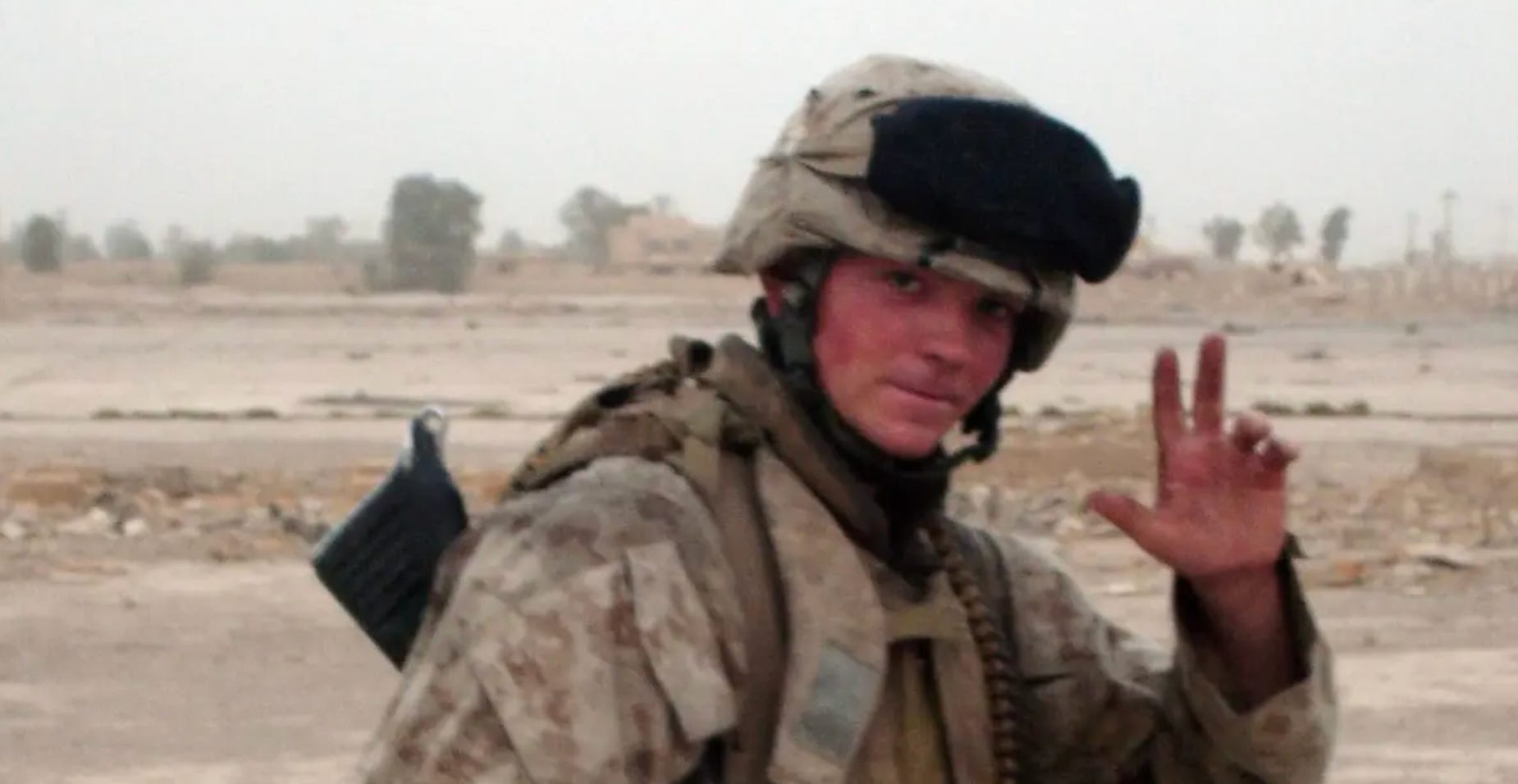
It is especially foolish to bet against a man who represented this state across the forever wars his country sent him to fight. Maine is the state of Joshua Chamberlain and Gary Gordon. The voters there understand that human beings are complicated, and that the men who volunteer to carry rifles on behalf of the rest of us are rarely saints. They are often brave, flawed, stubborn, impulsive, and sometimes difficult. They are, in other words, human. Platner is no exception.
I think it’s worth examining that, for some of us, Platner’s struggles are a part of his appeal, not detrimental to it.
He said dumb things. He did dumb things. It seems like he has, underneath his gruff willingness to say what needs to be said in this nation under hot spotlights, a “being a prick” streak, problems with alcohol, and the sort of impulsive aggressiveness that is curated and encouraged in ground combat units where 99% of your problems can be solved by getting more violent and faster than the other guy. None of that is hidden, and none of it needs to be excused. But as a ground combat veteran myself, I want to tell you that being one is different in kind, not degree, from what other veterans, even ones who deployed to Iraq and Afghanistan. experienced.
Why do I relate to Platner? Well, in January 2005, when we both were in Iraq, my unit, a SEAL platoon, had as its platoon baseball hats the emblem of the Knights Templar and “infidel” written in Arabic on the back. We weren’t expressing an opinion on the Crusades; we just thought it looked gangster (there was barely even Wikipedia back then). At the SEAL Team, one could buy a T-shirt that said: “I support Iraqi Prisoner Abuse.” No joke. Did we really believe that war crimes as policy were good? Or were we 23 years old and doubling down on being tough and aggressive when our friends were trickling home in body bags and we had been taught that being tough and aggressive would keep us alive? On my platoon commemorative plaque from that deployment, we misspelled “Fallujah.” I once (it’s been deleted, but I’m pretty sure the verbage is close) called Donald Trump Jr. “an oxy snorting nepo fucktard,” on what was then Twitter in the first Trump term. I may have used the “R” word. I’ve definitely called some MAGAs the “P” word.
And despite all that, maybe in part because of that, I’ve spent hours and years devoting real thought and writing to making sense of all that and how to turn it into a positive for the nation in whose name I went to war. I think about the war. I think about the war. I think about the war. Every. Single. Day.
I try to construct meaning from it and use it to build something positive, which I believe I owe to my friends who came home under a flag.
Do you see where I’m going with this?
A tiny minority of Americans (6%) ever serve in the military. Of these, only 40% of veterans have ever deployed to a combat zone. And of those deployed, only about 10% participated in actual ground combat. I am one of those, and so is Platner. His pathology: a combination of traumatic stress, substance abuse, impulsive decision-making in the past, and deep anger at the moral injury he sustained wearing the cloth of this nation, is something this country ought to consider when it sends its young men and women to war. The question before Maine is not whether Graham Platner is perfect. The question is whether the United States Senate, the state of Maine, and the country as a whole would benefit from having his voice in the room when decisions are made.
The answer is yes.
Platner understands something that far too many people in politics only understand abstractly. He understands what war does to young men. He understands the cost that is paid long after the speeches are over and the flags have been folded away, and on a personal level, he continues to pay that cost. As do I. As do so many others who swear too much and look back on that time in our lives as the best worst time we ever had. As the time in our lives when we were truly needed by other men we respected. As a time when we were an essential part of a tribe with its own rules, shibboleths, and taboos.
Last night, a very close SEAL friend I have known for 25 years texted one of my frogman group threads about how he was struggling right now. About what?
He was having a hard time with the fact that he had ordered reinforcements to fly to aid a small group of SEALs about to be overrun. They were overrun, and the rescuers did not make it in time. His pain last night was that the men on the ground thought they were going to be saved, that they had hope, and they died anyway. This incident was over 20 years ago.
Moral injury stays with you longer than a moronic tattoo.
We who have intimately seen ground combat know that every human being carries an animal inside of them. Most of you are fortunate enough never to meet it. A small number of people are forced to. And we learned things about violence, fear, courage, guilt, loyalty, and human nature that cannot be learned in a classroom, a think tank, or a Senate hearing room.
The value of that perspective is not that it makes someone more eager to use force. Quite often, it has the opposite effect. Those who know violence best are frequently the least romantic about it. They understand both its necessity and its cost. They understand that protecting a nation’s borders, interests, and citizens is a fundamental responsibility of government and must be done as effectively as possible, and that this does not mean as cruelly as possible.
What strikes me most about Platner is that he belongs to a tradition the American left has spent, at least the Trump years, searching for without fully realizing it. We have been waiting for our own version of General Grant: a flawed man, imperfect in his personal life, rough around the edges, but willing to fight relentlessly for principles larger than himself.
Grant drank too much. His critics never let him forget it. Yet he also broke the back of the slave holding Confederacy, defended Reconstruction, and fought for the proposition that equality under the law was not a political convenience but a moral necessity. His imperfections did not negate his virtues; they existed alongside them.
For me, those things are straightforward. Equality of opportunity is not merely a policy preference; it is a moral requirement if we aspire to be a moral nation. Our citizens deserve security. Our borders deserve protection. Our interests deserve defense. But all of these goals must be pursued with competence, restraint, and an understanding of human consequences. That combination is rarer than many people think, but I believe it exists in Platner.
I suspect I am not alone in wanting a representative who can speak those truths to power. I suspect I am not alone in believing that lived experience matters, that service matters, and that a person does not have to be flawless to be worthy of trust.
In fact, I would argue the opposite. A democracy that insists on perfection will eventually find itself represented only by people skilled at hiding their flaws.
So if this is all there is, if the case against Graham Platner is that he is imperfect, stubborn, occasionally self-destructive, and deeply human, then I would not bet against him, I would bet that Maine will choose to send one of its own.
Scott Galloway said something that I appreciate. As long as what someone did is not a pattern. Everything that trump is doing right now has been a pattern throughout his life. Unfortunately he was still voted in.
I am 80. I fought in Vietnam in 1968, which was a terrible year. I think of myself as a decent man. But I was 23 in that war, the old man in the platoon I led. We needed courage, so we put up a sign that said, “Yea, though I walk through the Valley of the Shadow of Death, I fear no evil, for I am the meanest mother fucker in the valley.” Beneath the sign sat a human skull.
Was that me a year later? Is that me now? No. But unless you have been in the fight, you simply do not know.
War warps humanity.