Say Nothing

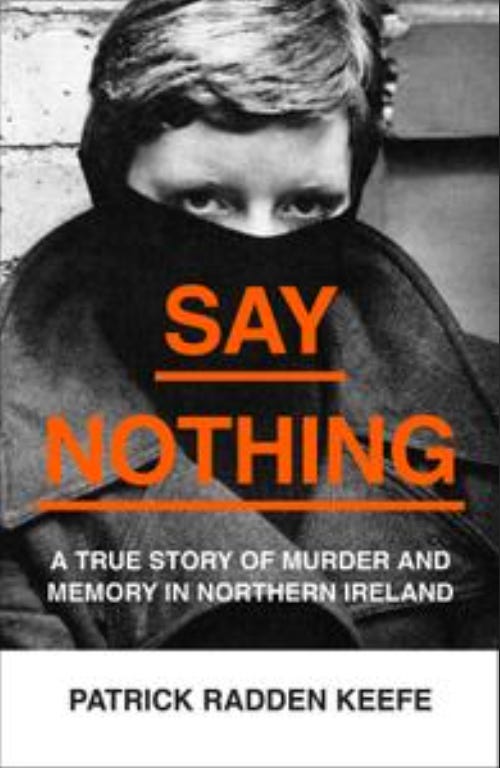
I finished reading Say Nothing by Patrick Keefe last week and then immediately binged the Hulu Series, finding myself reflecting on an old conflict thousands of miles away that still felt familiar growing up in New England.
As a kid, I delivered the Boston Globe on my bicycle, northeast of Boston on the New Hampshire border. My grandmother was Irish Catholic, married to a Scots-Irish Presbyterian by way of Quebec. We didn’t sit around the dinner table discussing the IRA, Gerry Adams, or the Troubles, but I was aware of it. Nobody gave me lectures on British colonialism or republicanism. Yet the Troubles were somehow there anyway, floating through the background radiation of childhood. There were occasional newspaper headlines, I was told never to wear orange on St. Patrick’s day, and Bloody Sunday, was known as a thing that was somehow as bad as the Challenger disaster, but different. As Americans in the last days of the Cold War, England was our friend and ally, except when it came to Ireland. I knew that when my grandmother asked “what’s an Irish 7-course meal?” the answer was “a potato and a six pack,” and I also knew it was a joke only appropriate in certain company.
The awareness was less a conversation than a gestalt.
Watching Say Nothing decades later, I was struck by how accurately it captured what always seemed to hover beneath the surface. The Troubles were about people trapped inside competing visions of the future. They were about history’s ability to make reasonable people do unreasonable things, and when I was old enough to learn of them, they seemed mostly about what happens when two groups become convinced that compromise is betrayal. Of course, they were also about time.
Everyone in Northern Ireland seemed to be living on a different timeline. Some wanted freedom immediately. Others wanted revenge. Enough wanted peace. Some wanted all three at once. Some were chasing what they believed to be freedom, some thought they could have their cake and eat it too.
No figure embodies that contradiction more than Gerry Adams.
To call Adams a politician is both a compliment and a slur.
It is a compliment because politicians, at their best, accomplish the impossible. They persuade people to stop killing one another. They build coalitions between groups that hate each other and create enough common ground for peace to emerge. Gerry Adams helped do that. Whatever else can be said about him, Northern Ireland today is immeasurably better than Northern Ireland during the height of the Troubles.
It is also a slur because politics often demands moral compromises that would be intolerable in ordinary life. Adams helped bring peace, but he did so carrying the weight of decisions that contributed to violence. Thousands of people died because of choices made by IRA leaders. Peace did not arrive because one side was right and the other was wrong; it arrived because, eventually, being that right has a way of exhausting you.
That is a difficult truth.
How do you forgive someone who helped end a war but also helped wage it? I wonder sometimes about the Vietnam veterans like Hugh Thompson who traveled as middle-aged men back to the hamlets they once fought to the death in, and wonder what it would be like to sit at a cafe in Fallujah someday. I don’t know if that will ever happen for me, as that may be profoundly unsafe for the rest of my life, but even that raises an important question: how do you forgive people who are not ready to be forgiven?
That’s increasingly relevant in America.
Some of our countrymen and women will go to their graves believing January 6th was righteous. Others will go to their graves believing Joe Biden remained fully lucid throughout his presidency. Some will insist every recent war was necessary, and others will insist none were. Many of us will soften our views as the years pass. Some will not.
Regardless, history sure won’t.
Our grandchildren will study us the same way we study the people of Belfast. They will examine our certainties. They will wonder why we fought over the things we fought over. They will look at our social media posts, our cable news segments, our political slogans, and they will ask the same question we ask when looking back at earlier generations:
“What were they thinking?”
The uncomfortable answer is that they were probably thinking exactly what we are thinking now. That they were right, the other side was wrong, the stakes were existential, and any compromise would be turned against them.
Every generation believes it occupies a uniquely important moment in history and that its enemies are uniquely foolish and its allies uniquely wise. Then enough years pass, enough documents are opened, enough participants die, and you hear Brendan Hughes’ final assessment that Gerry was a tout and a sellout and maybe Jean McConville shouldn’t have been clipped after all.
The Troubles feel distant now because time has sanded down the sharp edges. My grandmother is 20 years gone now. One day, that same thing will happen to us.
I suspect America will remember Trump and MAGA poorly and that history will view much of it as a politics of grievance, anger, and nostalgia. The cruelty is a national low point, the abdication of moral leadership is short-sighted and corrupt. Yet I also suspect history will judge Democrats harshly for a different failure. Too often, they seemed afraid to say no to anyone, even as wokism reached its most ludicrous heights, they were afraid to establish priorities, afraid to acknowledge tradeoffs, afraid to govern with the confidence their own voters expected of them.
Historians and the truth itself rarely grant monopolies on failure, it usually gets spread around.
So much of our energy has been consumed by these fights. We are the wealthiest and most technologically capable civilization that has ever existed and we should be curing cancer, building bridges and infrastructure across the developing world. We should be constructing solar farms across Arkansas and Kansas and solving desalination. We should be preparing missions to Mars. Instead, we spend enormous amounts of time arguing about where your rights end and mine begin.
In American history, that’s probably par though. Our ancestors argued about religion, kings, and slavery. They argued about who belonged and who did not, and drew those lines on things some of us find inconsequential and some of us view as scripture. I don’t particularly care if I overhear someone speaking Spanish at the grocery store, but enough in this country seem to.
Our grandchildren will inherit our arguments, and that is what Say Nothing ultimately reminded me of. The people caught inside the Troubles did not know how the story ended, which convictions would age well and which would age terribly. They did not know what future historians would praise or condemn; they were too busy living inside history while it was still unfolding.
Perhaps the most useful lesson is then, is humility. The certainty we feel today will one day belong to the past. I’ve been alive long enough to see things I was once certain of melt. The people we despise may eventually be viewed with sympathy, and the people we admire may someday be viewed with skepticism. The causes that consume us may appear smaller than we imagine, while the problems we ignore may prove far more important. Those who exploit these rifts for personal gain, like Donald Trump, will die and be buried. We will all move on.
Maybe one lesson of the Troubles is that we will all be better for it.
Excellent essay, after reading it I sit here and feel humble in a way that I hadn't thought about in quite some time. Thank you and I will be watching the series you reference this coming week. Hope you enjoy your weekend ☺️
Huh...William Manchester in Goodbye, Darkness and Tim O'Brien in The Vietnam in Me both discussed traveling to and revisiting the places of their wartime trauma. Give them a read if you haven't already, Dr. Barkhuff, and thanks as always for your insight.