Stoicism Today

I can’t think of a better entry point into stoicism than Donald Trump’s second term. I didn’t always understand that. During the first Trump term, I was all-in, founding Veterans For Responsible Leadership, organizing, fundraising, running ads, doing the endless Zoom calls that define modern political combat. It felt like duty. Or at least, it was the version of duty I understood at the time: oppose what you believe is wrong, as loudly and persistently as you can, using your best weapons.
My best weapon was I was a SEAL. My second-best weapon was the refusal of any monetary compensation for the thousands of hours I put into it. Those two things gave me credibility that not everyone had.
Maybe it helped, maybe it didn’t. In 2020, I allowed myself to believe we had some small effect. But by 2024, after seven years of pushing against the same current, I felt something else creeping in: not defeat, exactly, but a kind of burnout that no amount of caffeine or righteous anger could fix. The work had become performative even to me. The most important variable in that kind of political effort is self-motivation, and mine was running dry. How many times can you ask strangers for money to fund ads against people who seem immune to shame? How many calls can you sit through before you start to feel like you’re reciting lines in a play that never ends?
So I stepped away in the final days of the Biden Presidency. Others wanted to carry it forward, and they should. But I needed to reset.
What I didn’t expect was how much harder it would become once I stopped trying to influence events. Because when you’re in the arena:fundraising, organizing, reacting, you at least have the illusion of control. Once you step back, you’re left with something more uncomfortable: the reality that most of what unfolds politically is entirely outside your hands.
And then came the second term.
News that would have once dominated weeks of coverage now flickered and disappeared in days. Reports of El Salvadoran prisons, rising prices that pressed hardest on people already stretched thin, the distinctive “pop-pop” of 9 mm into defenseless protestors. Every news cycle looped further and further away from the kind of America I wanted my children to inherit.
But here was the problem: I couldn’t live in news cycles.
Not in any meaningful, immediate way. Not in the way my instincts demanded.

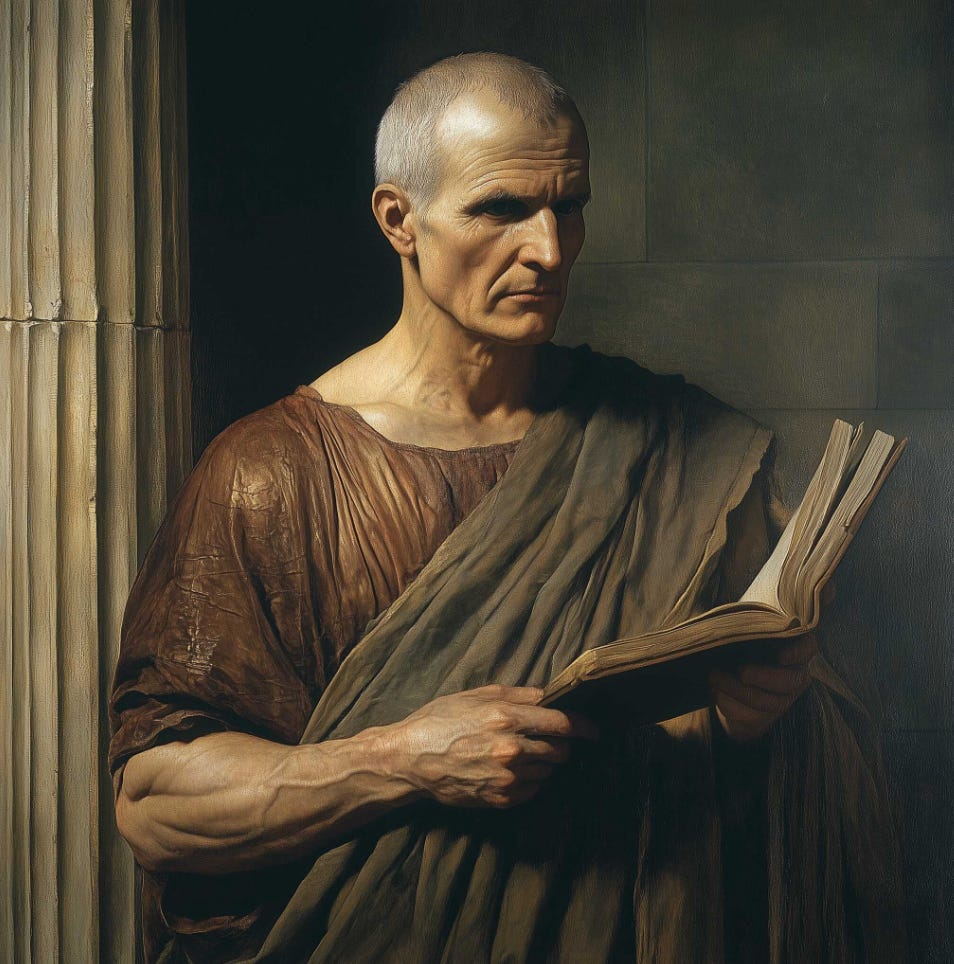
That’s where Stoicism stopped being an abstract philosophy and became something closer to a necessity. I had read Marcus Aurelius before, of course. Everyone has, who attended a service academy. His Meditations sit on shelves and in Instagram captions, reduced to aphorisms about resilience and discipline. But reading Stoicism and needing it are two very different things. It’s one thing to nod along with the idea that you should focus only on what you can control. It’s another to confront a world that is actively pulling your attention toward things you cannot control, and to choose, deliberately, repeatedly, not to be pulled.
It’s really hard.
Because once I decided, however imperfectly, to aspire to that Stoic frame, there was no other coherent way to view Trump or the era surrounding him. His actions, his rhetoric, the constant churn of provocation, these are external events. They exist outside my control. My reaction to them, however, does not. That’s the only domain that belongs to me.
And if I surrendered that, if I allowed every headline to dictate my emotional state, then I wasn’t engaged in civic life. I was being acted upon. I was the mark. I was falling for the bait.
Epictetus or Stockdale would call that a kind of slavery.
So I started to experiment with a different posture. Not withdrawal, but recalibration. When something enraging surfaced, I tried to pause and ask a simple question: is there anything I can do about this, right now, that will materially change it? Most of the time, the answer was no. And accepting that wasn’t defeatist, it was clarifying. It freed up energy that had been wasted on reactions and redirected it toward something else.
Toward writing. Toward thinking. Toward trying to articulate a better way of being in a time that rewards the opposite.
Writing about discipline, decency, and duty isn’t skipping out on picking a side when you realize we’re not fighting, ultimately, against an octogenarian autocrat; we’re fighting against the worst aspects of the American psyche. Corruption, racism, and cruelty have always been in tension with courage, charity, and wisdom in this land.
We do, now, live in a moment where decency and a belief in the sanctity of human life are subversive. Where humility is mistaken for weakness, and restraint for irrelevance. The incentives all run in the other direction: toward outrage, toward certainty, toward the performance of moral superiority. It’s a system that feeds on attention and converts it into division.
Stoicism cuts against that current.
It asks you to lower your voice when everyone else is shouting. To examine your own reactions before condemning someone else’s. To accept that the world is often unjust, and that your role is not to fix it in one sweeping gesture but to meet it with clarity and steadiness. It demands humility: not the performative kind, but the quieter recognition that you are not the center of events, that history will unfold with or without your approval.
That doesn’t mean you do nothing. It means you choose your actions carefully, and you measure them not by how loudly they announce your virtue, but by whether they align with it, and whether they work.
For me, stepping away from VFRL wasn’t an abandonment of duty. It was a redefinition of it. They are doing excellent work this cycle, and I still help from time to time with fundraising, chatting with candidates, etc. Duty is not just what you do in the arena; it’s how you carry yourself when you step out of it. It’s whether you can resist the pull of constant reaction and instead build something more durable: ideas, habits, a way of engaging with the world that doesn’t depend on the ramblings of a defective personality in power.
The Stoics posit that if you are distressed by external things, it is not those things that disturb you, but your judgment about them. I used to resist that idea. It felt like a way of minimizing real harms, of retreating into philosophy while others bore the consequences of political decisions.
Now I think I misunderstood it.
It’s not about denying that harm exists. It’s about preserving your ability to respond to it in a way that is deliberate rather than reactive. Because if you lose that, if you let yourself be carried along by every surge of anger or despair, you’re not actually helping anyone. You’re just another participant in the churn.
And the churn is endless.
The next three years will be long. There will be more moments that feel intolerable, more events that demand a reaction. I don’t expect to meet all of them with perfect Stoic composure. No one does. But the aspiration matters. The decision to try to hold onto some core of steadiness in a world that profits from instability matters.
Because in the end, that’s the only real control we have.
It's taken me 10 years of this chaos to be able to accept the fact that I have NO power or control over the world today. I am trying to live one day at a time, grateful I'm retired,& happy to wake up every morning.
There are so many knowledgeable historians, Applebaum, professors, Synder, media giants, D. Rather that are sounding the alarm vigorously that it's hard to reset. Then the thought of becoming involved with a cause enters my mind. As you said what if it then feels that I'm not having an effect anyway. I'm resolved to stay in my lane and stay informed. Vote. Contribute. My wife and daughter are too frightened to protest. They don't want me to go. No Kings Day here in Minnesota should be big. Thank you for the thoughtful words. Always meaningful.