Thoughts on Navy SEALs

There’s this thing I remember from around the time I had just “gotten my bird”, the colloquial term we used in the SEAL Teams to describe being “warfare qualified,” aka a SEAL, aka a lifetime pass to have people click on a Substack article you write on the couch with a 7-year-old asleep next to you… Katie Couric is on the news, she’s hearing some report of the opening night of Operation Iraqi Freedom, the dumbest possible way a nation could respond to a terror attack, and she lets out an enthusiastic “Navy SEALs Rock!”
I should have been alarmed, but I wasn’t; I thought it was awesome.
So what I’m pondering, could the Navy SEAL phenomenon, everything from the real operators to the fanboy worship, the political mythology, the influencer masculinity branding, have emerged in any other country, in any other era? I sorta don’t think so. In fact, I’m increasingly convinced that the American SEAL myth could have happened only here, and only in this narrow window of time where technology, politics, capitalism, and masculine insecurity converged into a perfect cultural storm.
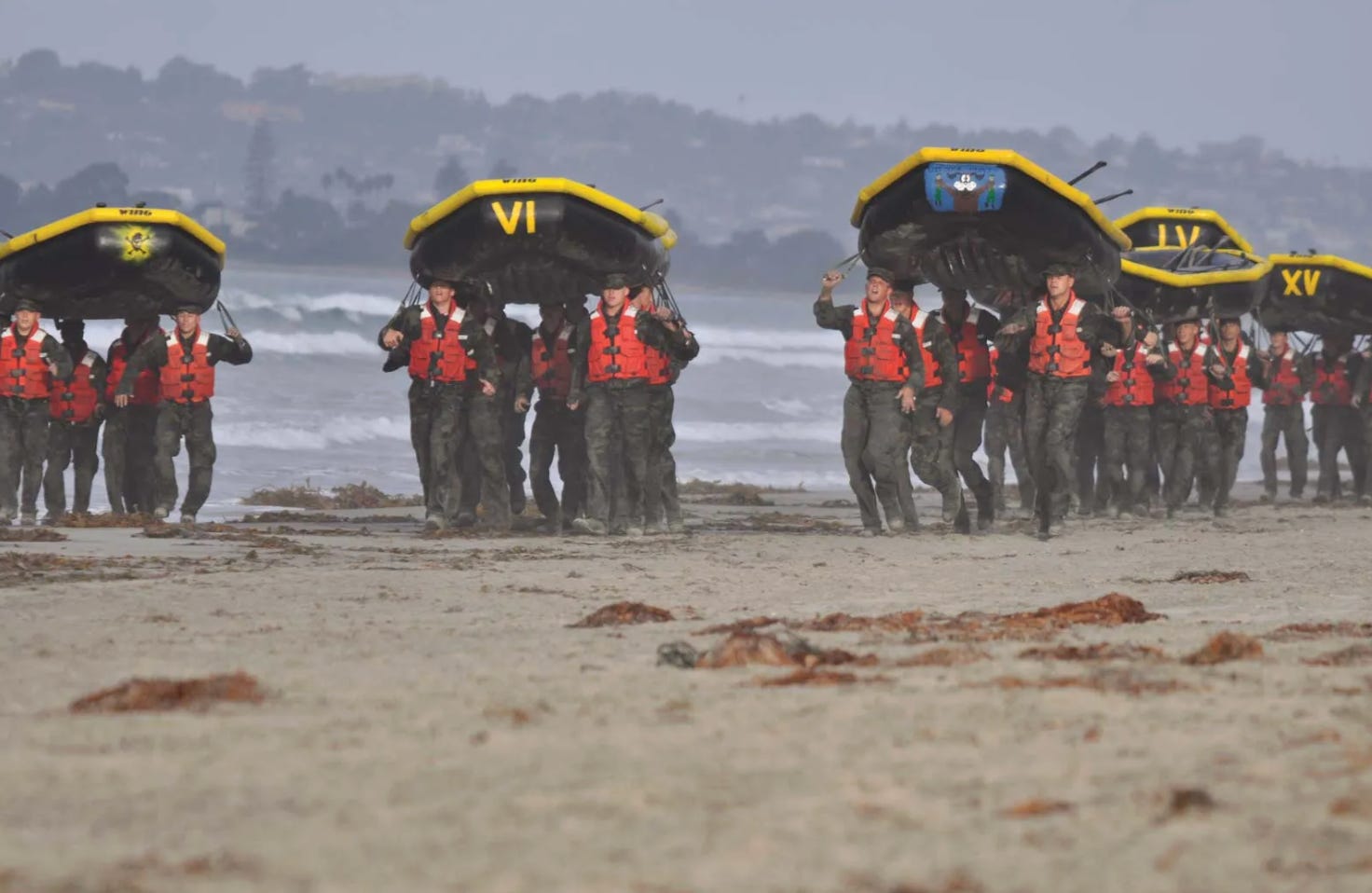
Because the thing people forget, or never learned, is that SEALs were not built to be what they have become. They were not created to be podcasts, or fitness brands, or political mascots. At least not intentionally. They weren’t meant to be motivational philosophers or avatars of “authentic toughness,” though if I’m being honest, I hear that siren song loud and clear. SEALs were designed for a much older, darker purpose: to swim up to places like Omaha Beach, in the cold dark water, and blow up shit. They did the jobs that look, on paper, like the sorties of kamikaze pilots: missions where survival is nothing more than a statistical quirk. The difference is that American battlefield dominance now lets us live. But the original blueprint was closer to “disposable drone” than “influencer monk.” SEALs were the men you sent when something had to be done at night, in the surf, maybe under fire, with no guarantee of rescue and no expectation of applause.
Cause you were dead, floating in that same surf.
And yet, here, we’re demigods.
I know why you clicked on this link.
Because America sits on the largest media machine in human history, and the media needs stories. Hollywood, Madison Avenue, cable news, book publishing, and now podcasts, YouTube, TikTok, and Instagram mean no one has ever had the type of access we have to fantasy. It’s not propaganda; it’s capitalism fused to narrative. When the post-9/11 wars demanded a new kind of hero, a national response to boxcutters and mass murder, one leaner, quieter, less bound to mass conscription and more evocative of surgical modern warfare, we filled the role almost too perfectly. We were elite, “anonymous,” mysterious, and seemingly invincible. No kidding, we didn’t have anyone die in Iraq until waaaay later than almost every other SOF unit (I’m not sure about the PJ’s). We were small enough to be romanticized and real enough to satisfy a country that wanted to believe its warriors were doing the impossible while the rest of the nation went about its peacetime routines.
Germany had Otto Skorzeny in World War II, a man whose missions were bold enough to fill a dozen Hollywood scripts even if he was a garbage human. But Hitler never publicly drooled over him the way modern American populists worship Eddie Gallagher, a drug addict who was an expert at hurting people you aren’t supposed to hurt, including other Americans. Nazi Germany didn’t build a personal-brand ecosystem out of Skorzeny; they used him when he was useful and discarded him when he wasn’t. Leni Riefenstahl never made a string of movies glorifying individual SS operators, because authoritarian propaganda doesn’t work that way. Totalitarian states center the myth on the leader, not the subordinate. The idea of Hitler lifting up a specific commando as the embodiment of German masculinity the way Trump does with SEALs is absurd. It would have been a threat to the Führer, not a boon.
But America is different. Our authoritarian temptations are different, too. Instead of worshiping the state, our populist movements worship rule-breaking as authenticity. Someone like Gallagher isn’t a hero because he was disciplined; he’s a hero because he symbolizes contempt for the idea that the use of force should be restrained or morally accountable. He fits perfectly into a movement that equates cruelty with courage. Trumpism didn’t distort the SEAL myth so much as reveal what parts of it were always there for the taking. It found the operator archetype waiting like a loaded weapon and fired it into American politics.
But the larger myth: Jocko, Goggins, Luttrell, the entire motivational-industrial complex, required something else, technology. It doesn’t exist without the rise of long-form podcasting, viral video, and algorithmic identity formation. Only in the last twenty years have former operators been able to speak directly to millions of men through their own curated channels. And only in this era have so many men been hungry for a story about shortcuts to being tough without doing tough things.
Here’s the truth: America is in a profound masculinity recession. The old scripts have been erased. Many men feel aimless. I see them in my jujitsu gym. They can’t resist buying into that vacuum; the SEAL archetype arrived. Here is a model of manhood that seems elemental: strong, quiet, purposeful, tribal, unquestionably competent. And because this is America, that archetype was immediately monetized, franchised, politicized, and exported. What should have remained a quiet professional tradition became a self-help brand, a workout program, a leadership seminar, and eventually, a political identity.
But beneath the myth, the real SEALs remained what they always were: the men who swim ashore on nights when the Republic needs something done in the dark. The men who were built for Omaha Beach. The original job descriptions read like kamikaze missions. They were not meant to be what America later made them. The fact that we turned them into symbols of national virtue, political rage, commercial inspiration, and cinematic fantasy says more about us than about them.
Navy SEALs could never have happened in another country. Those cultures could have produced the operators, but they could not have produced the myth. The myth required a fractured, media-drunk, lonely, hyper-capitalist America. The SEALs became the vessel for that contradiction because the real work they do, silent, dangerous, disciplined, organizationally flat, was too boring or too painful for a country addicted to spectacle.
I once heard about the SEAL Teams a criticism I’ve never forgotten: do they have the best culture they could have? No. Do they have the culture they want, though? Absolutely.
God, I’m proud of having been one of them.
Even when I’m not.
I personally am alarmed at the number of former SEALS I see running for political office who embrace their inner fascist. I am thankful for your thoughtful commentary. Too many SEALS buy into the hero worship of extreme violence.
I can take it back even farther, Dan. What got me was Barry Saddler singing “Fighting Soldiers from the Sky.” That was almost pre-SEALS. I went through jump school with a platoon of SEALs, and that was the first time I ever heard of them. Then came Marchinko and Rogue Warrior. He did a lot of damage. The daughter of a good friend, a former SF guy who served in RVN, married one of the plankholders in DEVGRU. He died on her and then she discovered he had failed to un-marry his former wife. '
So Rogue becomes vogue, and here we are.
I had dinner last night with a guy who went through BUDS 32, or something like that. He is 84. He stuck with UDT and cleared the beaches at Danang for the Marines to land. He and his boys were standing on shore in their shorts and K-bars, smoking cigars and holding signs saying Welcome Marines.
He was not rogue. You were not rogue. But a lot have become so.